Baking did not begin with ovens.
It began with accident.
Thousands of years ago, someone mixed crushed grain with water. Perhaps it was meant to be porridge. Perhaps it was left too close to the fire. But when that paste met heat, something changed. It hardened. It browned. It became food that could be carried, stored, shared.
But how did they bake it?
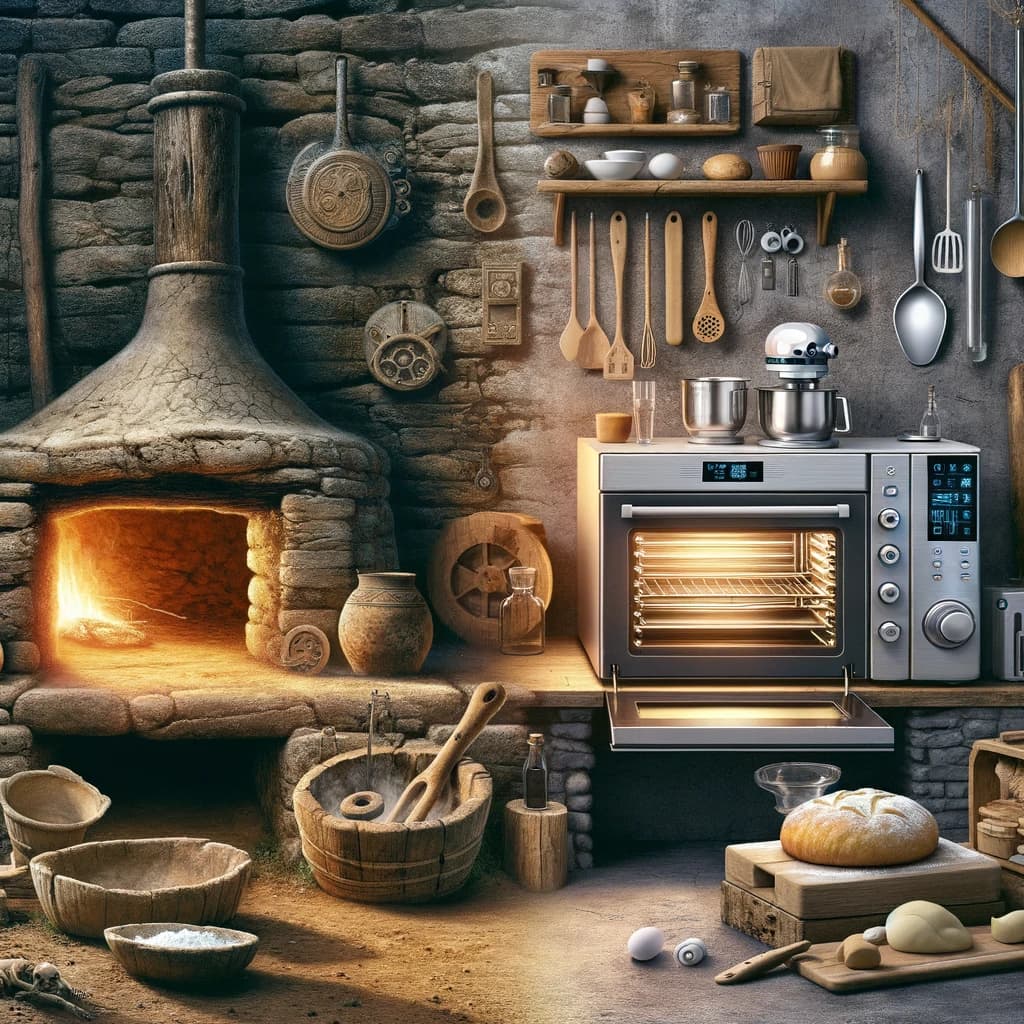
There were no metal tins. No thermometers. No measuring scales. The first baking tools were stones heated by open flame, shallow clay bowls shaped by hand, and dome-shaped mud ovens built from earth itself. Grain was crushed between rocks. Dough was mixed with bare hands. Heat was judged by instinct and memory.
From these humble beginnings of fire, stone and clay, the long evolution of baking tools quietly began.

From Hearth to High-Tech: Tracing the Evolution of Baking Tools Across Centuries.
Ancient Beginnings: Fire, Stone and Clay
In ancient Mesopotamia and Egypt, grain was ground using stone querns. Dough was shaped in simple vessels and baked on hot stones or inside early clay ovens. Over time, these developed into more structured, enclosed ovens such as the Roman fornax, communal wood-fired structures capable of baking multiple loaves at once.
There were no dials to turn. No gauges to consult. Skill was measured not by equipment, but by experience.
The baker learned to read flame, ash, colour and smell.
The Medieval Kitchen: Communal Ovens and Marked Loaves
In medieval Europe, few households owned private ovens. Most families brought their shaped loaves to communal ovens owned by a lord or municipality.
Wooden paddles were used to load bread into ovens. Dough was mixed in heavy wooden troughs. Iron hooks and coarse sieves were essential tools.
Everything required physical effort. Baking was labour.
The Industrial Revolution: Precision and Metal
The 18th and 19th centuries reshaped domestic baking.
Cast iron ovens allowed for more controlled heat. Enclosed kitchen ranges replaced open hearths. Metal cake tins introduced consistency in size and shape. Rolling pins became standardised. Flour sifters refined texture.
In commercial bakeries, mechanical dough mixers began to appear in the late 19th century, reducing the physical strain of kneading large quantities of dough.
For the first time, baking shifted from pure strength to mechanical assistance. Standardisation slowly replaced guesswork.
The 20th Century: The Rise of the Home Baker
Electricity transformed the kitchen.
When stand mixers entered domestic households in the early 20th century, mixing and kneading became faster and more efficient. Electric ovens allowed bakers to control temperature with far greater accuracy. Measuring cups and spoons became standardised, making recipes more reliable across households.
Baking was no longer limited to professionals or communities with access to wood-fired ovens.
It became domestic. Repeatable. Predictable.
The light sponge cake and precisely structured loaf became possible not only through ingredients, but through tools.
The Digital Age: Accuracy and Accessibility
Today’s baker works with tools that earlier generations could scarcely imagine.
Digital scales measure to the gram. Oven thermometers eliminate hidden temperature discrepancies. Silicone mats provide even heat distribution. Bread lames allow controlled scoring. Stand mixers knead dough in minutes.
Knowledge itself has become a tool. Online tutorials, detailed temperature guides, and even AI-powered baking assistants have made technique accessible in ways once reserved for apprenticeships.
And yet, despite all this innovation, the essentials remain unchanged.
Flour. Water. Heat. Time.
What Has Not Changed
Across centuries, tools have improved efficiency, precision and comfort. But they have never replaced instinct.
The Roman baker and the modern home baker share something fundamental: both must understand dough, fermentation and heat. Equipment may assist, but it does not eliminate judgement.
In many ways, today’s revival of sourdough and heritage breads reflects a return, using modern tools to rediscover ancient rhythms.
From Hearth to Heritage
The evolution of baking tools tells a story not only of invention, but of access.
From communal ovens to private kitchens.
From hand-kneading to stand mixers.
From guesswork to digital precision.
Each generation reshaped baking, and yet the heart of it remains remarkably steady.
The next time you switch on your oven or weigh flour on a scale, you are participating in a lineage thousands of years old.
And perhaps that is the most enduring tool of all: continuity.