Around the World in 80 Bakes: Stop #25 — Christmas Bakes
When the days grow short and the nights stretch long, something begins to stir in kitchens across the globe. Flour is sifted, spices are measured, ovens warm, and age-old recipes are brought back to life. Christmas, in every culture that celebrates it, has a scent — of cinnamon, cardamom, butter, and sugar — and a taste that’s steeped in memory.
Though the exact flavours vary from one country to another, the impulse is the same: to gather, to give, and to bake.
Here’s a deeper look into how different nations mark the season with their most beloved festive bakes — and the stories that live inside each one.
🇩🇪 Germany – Stollen
The fruit bread with a papal seal
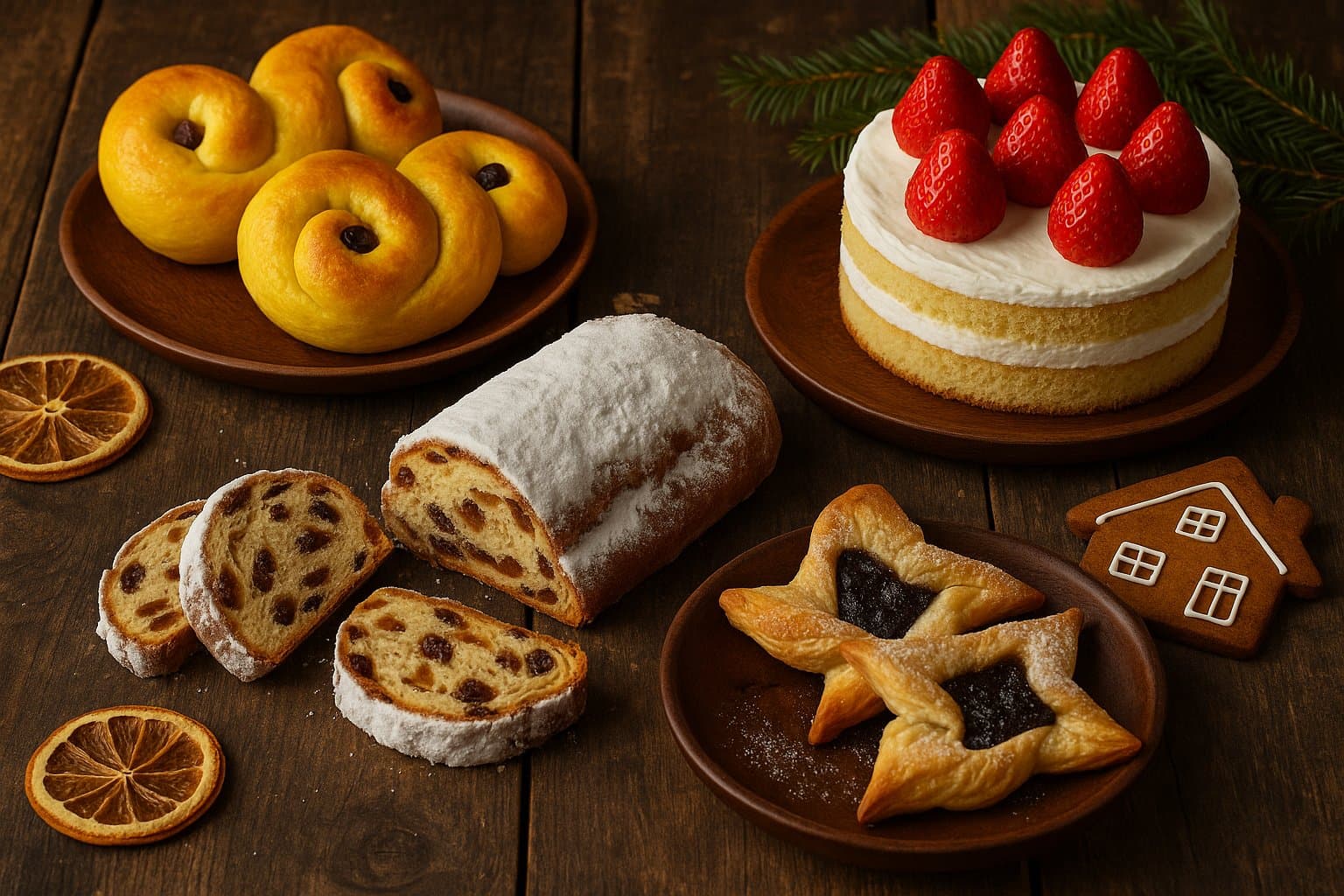
Stollen, or Christstollen, dates back over 500 years to the German state of Saxony. The earliest versions were starkly plain — made only of flour, yeast, and water — due to strict Catholic fasting rules that forbade the use of butter during Advent.
This changed in 1491 when Prince Ernst and Duke Albrecht of Saxony sent a formal request to Pope Innocent VIII, asking for permission to use butter in their festive bread.
The Pope replied with the now-famous “Butter Letter” (Butterbrief), granting them and their household the right to bake with butter — provided they paid a small fee to fund the building of a church.
This papal letter paved the way for what Stollen is today: a rich, spiced loaf filled with dried fruits, citrus peel, nuts, and often a marzipan centre, generously dusted in icing sugar to resemble winter snow.
The loaf’s shape is said to symbolise the swaddled Christ Child, making it not just a treat but a religious symbol on the Christmas table.
🇸🇪 Sweden – Lussekatter (Saffron Buns)
A golden glow in the dark Scandinavian winter
Lussekatter are saffron-flavoured yeasted buns traditionally baked on 13 December, the feast day of St Lucia (or Saint Lucy). Lucia was a young noblewoman from Syracuse, Sicily, who secretly brought food to persecuted Christians hiding in the catacombs during the early 4th century. To light her way through the tunnels, she wore a wreath of candles on her head — freeing her hands to carry supplies. She was later martyred for her faith and became one of the earliest Christian saints.
Her story travelled north with missionaries and traders, and over time, merged with older Norse midwinter festivals that celebrated the return of light after the darkest part of the year. In Sweden, Lucia’s Day evolved into a beloved blend of Christian and pre-Christian symbolism, with candle-lit processions led by girls wearing white robes and Lucia crowns.
What do Lussekatter mean for Swedes today? More than just buns, they are a symbol of hope, light, and warmth. The soft golden spirals are shared at homes, schools, and workplaces — often during quiet candle-lit breakfasts on 13 December — marking a moment of peace and brightness amid the long Nordic winter.
🇫🇮 Finland – Joulutorttu (Christmas Star Tarts)
Star-shaped pastries with a prune-filled past
Joulutorttu, Finland’s classic Christmas tart, is a simple but deeply symbolic pastry made from buttery puff pastry folded into a star and filled with prune jam. Its appearance in Finnish cookbooks dates back to the late 19th century, although its popularity likely grew alongside the rise of home ovens and ready-made jams in the early 20th century.
The five-pointed star shape is widely believed to represent the Star of Bethlehem, which according to Christian tradition guided the Three Wise Men to the birthplace of Jesus. In some regions of Finland, particularly among older generations, the tart was referred to as Betlehemin tähti — literally “the star of Bethlehem.” While there is no single inventor or official origin story, the star design likely emerged from a blend of Christian symbolism and Nordic craft, where precise folding and shape manipulation were often part of festive baking rituals.
Today, Joulutorttu is part of nearly every Finnish Christmas celebration. Whether handmade or bought from bakeries, they appear in homes throughout December, offering a comforting blend of crispness, sweetness, and tradition. Served with coffee or glögi, they evoke a sense of quiet warmth amid the frost.
🇮🇹 Italy – Panettone
The Milanese dome that took over the world
Panettone’s history is a rich blend of legend and slow fermentation. One popular tale tells of a nobleman named Ughetto who fell in love with a baker’s daughter in 15th-century Milan. Disguising himself as an apprentice, he invented a sweet, enriched bread filled with fruits to impress her father. Another version credits the creation to a kitchen assistant named Toni, who saved a ruined dessert by improvising with leftover dough, raisins, and peel — hence pan di Toni (“Toni’s bread”).
Whatever the story, by the 19th century, Panettone had evolved into the tall, airy, fruit-studded loaf we know today — shaped using a paper mould to support its rise. Its texture comes from a long fermentation process using natural yeast (lievito madre), often fed and nurtured like a family heirloom.
It is traditionally eaten in thin slices with espresso, wine, or hot chocolate, and sometimes repurposed into toast or bread pudding once slightly stale. For Italians, Panettone is more than a dessert — it’s a gift, a gesture, and a centrepiece of the Christmas table.
🇫🇷 France – Bûche de Noël (Yule Log Cake)
A modern dessert from an ancient fire
The Bûche de Noël has its roots in the pre-Christian Yule tradition, where families burned a large log in the hearth to bring protection, fertility, and good luck into the home. The log, often chosen and decorated with care, would burn slowly through the twelve days of Christmas.
As homes modernised and hearths disappeared, the physical log was replaced by a more edible version. In the 19th century, Parisian pâtisseries began rolling chocolate sponge cakes into logs, filling them with chestnut or coffee cream, and decorating them with icing that resembled bark, moss, or even tiny sugar mushrooms.
Today’s Bûche de Noël may be elaborately flavoured with pistachio, raspberry, or mousse fillings, but it retains its symbolic link to warmth, family, and continuity — a sweet torch carried from past to present.
🇯🇵 Japan – Strawberry Christmas Cake
A Western-inspired dessert turned national icon
In Japan, Christmas is not a traditional religious holiday but rather a modern cultural event focused on romance, gift-giving, and celebration. At the heart of this modern tradition is the Strawberry Christmas Cake (kurisumasu keeki) — a light, airy sponge cake layered with whipped cream and topped with perfectly arranged strawberries.
Its origins lie in post-war Japan. During the 1950s, Western confections were seen as symbols of prosperity, modernity, and the good life. Fujiya, a pioneering Japanese bakery chain, marketed the strawberry shortcake as the “ideal Christmas treat.” Its white and red colours aligned beautifully with both Christmas imagery and Japan’s national palette.
By the 1970s, the cake had become inseparable from the idea of Christmas in Japan — not because of religious tradition, but as a celebration of hope, romance, and family. It remains so today, with bakeries across the country taking orders weeks in advance and shelves displaying hundreds of variations.
Want to try Japan’s most beloved Christmas cake at home? Here’s our easy strawberry shortcake recipe →
🇺🇸 United States – Gingerbread Houses and Cookies
An edible fairytale with centuries of spice
Gingerbread first arrived in America via English settlers in the 17th century, but it was the German tradition of Lebkuchen — combined with the popularity of the Brothers Grimm’s Hansel and Gretel — that sparked the creation of gingerbread houses.
By the 1800s, German-American communities in Pennsylvania and beyond were building intricate edible houses from spiced dough, held together with royal icing. With the rise of mass production in the 20th century, gingerbread kits became widely available, turning the tradition into a festive, hands-on family activity.
Gingerbread cookies, meanwhile, evolved into playful shapes — people, stars, trees — often decorated with coloured icing and candy buttons. Their warm blend of molasses, ginger, cinnamon, and cloves fills kitchens with the unmistakable scent of an American Christmas.
More than a dessert, gingerbread in the US is a craft, a bonding ritual, and often the first “bake” a child helps make. It speaks to nostalgia, creativity, and the simple joy of making something — and then eating it.
Why Christmas Baking Endures
What links these bakes — from a Milanese dome to a Tokyo strawberry sponge — is not the ingredients, but the intent. Christmas baking brings people together. It slows time. It draws on heritage, whether centuries old or newly created.
Even in modern kitchens, surrounded by gadgets and digital timers, the act of rolling dough, folding fruit, or sprinkling sugar feels old and grounding. And that’s perhaps what makes it magical: a return to something timeless, delicious, and deeply human.