Around the World in 80 Bakes: Stop #44 — Princess Cake
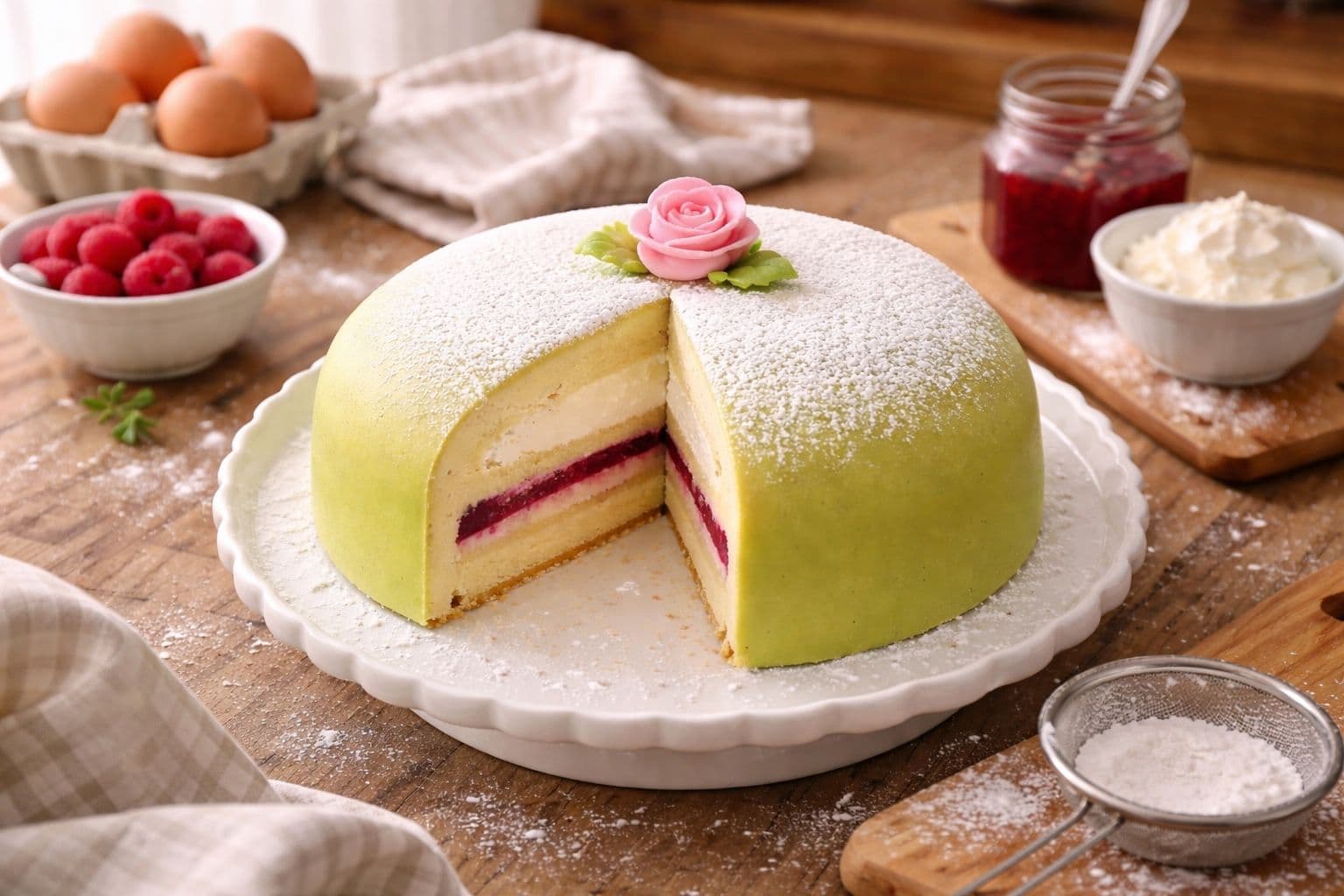
The Swedish Princess Cake, or Prinsesstårta (pronounced PRIN-sess-tor-ta in Swedish), is one of the most distinctive cakes in the world, easily recognisable by its green marzipan dome and delicate rose decoration. I often see it at IKEA in Singapore and enjoy having a slice, but its name always made me curious.
I recently spent four days in Stockholm and had a slice of Princess Cake at a cafe. Interestingly, this version was made with a generous amount of whipped cream and no raspberry jam, likely a more traditional approach. It was noticeably less sweet, allowing the lightness of the cream to come through. The bakery also made its own marzipan, which gave them greater control over the flavour and sweetness.
Experiencing it this way made me curious about how this cake came to be and why it has remained so enduring.
At first glance, it feels almost whimsical, even playful. Yet behind its elegant appearance lies an unexpected origin story that is shaped by royalty, education, and a changing view of domestic life in early 20th-century Sweden.
A Cake Born in the Royal Household
The origins of the Princess Cake trace back to the early 1900s, not in a bakery, but in the royal household of Sweden.
At the centre of its story is Jenny Åkerström, a pioneering educator who taught home economics to the daughters of Prince Carl, Duke of Västergötland. These daughters, Princess Margaretha, Princess Märtha, and Princess Astrid, would later lend their identity, quite unintentionally, to one of Sweden’s most beloved cakes.
Åkerström was more than a teacher. Her work reflected a broader shift in how domestic life was understood in early 20th-century Europe. At a time when cooking and household management were often dismissed as informal, inherited skills, she helped elevate them into a structured and respected discipline. Through her teaching, particularly within the royal household, she approached baking not as routine labour, but as a craft grounded in knowledge, precision, and method.
Her cookbooks reinforced this approach, presenting recipes with clarity and intent, encouraging consistency rather than guesswork. In doing so, she contributed to a wider movement that reframed domestic work as both educational and culturally meaningful, shaping how baking would later be taught, recorded, and valued.
From “Green Cake” to Princess Cake
The cake itself first appeared in Åkerström’s cookbook, Prinsessornas kokbok (The Princesses’ Cookbook), published in 1929 and later editions in the 1940s.
Originally, it was not called Princess Cake at all. It was known simply as “grön tårta”, the green cake, named after its distinctive marzipan covering.
The transformation of its name came not from marketing, but from affection. The three princesses were said to be particularly fond of the cake, enjoying it so often that it became associated with them. Over time, what was once a descriptive name evolved into something more symbolic: Prinsesstårta (the Princess Cake).
The Structure of the Cake: A Reflection of Its Time
The Princess Cake is not just visually distinctive; it is structurally complex.
Beneath its smooth exterior, it reflects a style of baking that took shape in late 19th- and early 20th-century Europe, when layered cakes became a way to showcase both skill and refinement. Earlier examples can be seen in Austrian and Central European tortes, such as the Sachertorte and other multi-layered sponge cakes where separate components like sponge, fillings, and glazes were prepared individually before being assembled into a single, cohesive dessert.
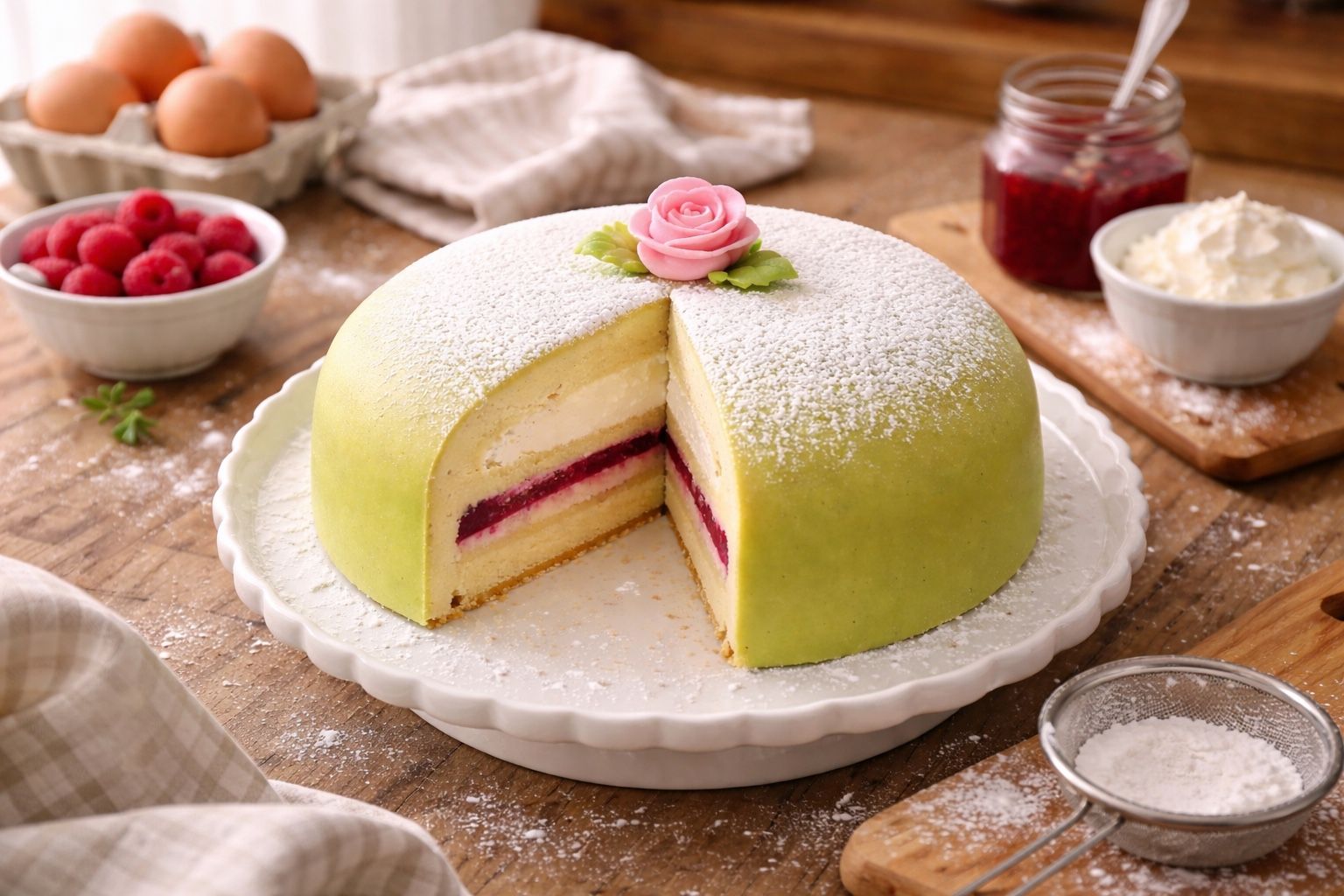
The Princess Cake builds on this tradition, combining sponge, pastry cream, whipped cream, and marzipan into a carefully structured whole. This complexity is intentional. Cakes of this kind were not everyday bakes, but centrepieces for special occasions, where effort, precision, and presentation carried as much meaning as flavour.
Traditionally, the Princess Cake consists of light sponge cake layers, vanilla pastry cream, a generous dome of whipped cream, a smooth covering of marzipan, usually green, and finished with a decorative pink rose on top.
Interestingly, early versions did not include fruit. The addition of raspberry jam, now common, came later as tastes evolved.
A Symbol of Celebration in Sweden
By the mid-20th century, the Princess Cake had become firmly embedded in Swedish culture.
While it is widely available today, being commonly found in bakeries, cafés, and even supermarkets across Sweden and the Nordic region, it remains closely associated with celebrations such as birthdays, graduations, weddings, and family gatherings.
Its significance lies not only in its appearance, but in the craftsmanship behind it. With its multiple components and careful assembly, the cake represents a level of effort and skill that elevates it beyond everyday baking, even if it is now easily purchased rather than made at home.
In 2004, its cultural importance was further cemented with the creation of Princess Cake Week, held annually in Sweden, with proceeds supporting charitable causes.
From Swedish Tradition to Global Icon
For much of the 20th century, the Princess Cake remained a distinctly Scandinavian classic, closely tied to Sweden’s café culture and traditions of celebration. It was a familiar presence in local bakeries and family gatherings, but rarely seen beyond the Nordic region.
Its wider international recognition began more gradually, shaped by migration, cultural exchange, and the global spread of European baking traditions. Swedish communities abroad, particularly in parts of the United States, helped introduce the cake to new audiences, where it appeared in specialty bakeries and Nordic-inspired cafés.
In recent years, however, the Princess Cake has experienced a notable revival beyond Sweden. Its growing presence internationally reflects several broader shifts in the baking world where European heritage recipes are being rediscovered and appreciated for their history and craftsmanship.
Visually distinctive desserts, especially those with clean lines and recognisable forms, are highly shareable in a digital, image-driven landscape.
There is also a renewed interest in vintage and nostalgic cakes, where classic designs feel both comforting and novel to modern audiences.
At the same time, global bakeries have begun to reinterpret the cake. While the traditional green marzipan remains iconic, variations now include different colours, flavour infusions, and even simplified versions adapted for contemporary tastes. Despite these changes, the defining structure of layered sponge, cream, and a smooth outer covering, continues to anchor it to its origins.
Today, the Princess Cake can be found far beyond Sweden, from Nordic bakeries to international cafés and even global retailers. Its journey from a royal teaching kitchen to a widely recognised dessert reflects not just the movement of recipes, but the enduring appeal of cakes that combine craftsmanship, elegance, and a sense of occasion.
Why the Princess Cake Still Captivates Today
The enduring appeal of the Princess Cake lies in its contrasts. Soft sponge against smooth marzipan; light cream against structured layers; and simplicity of flavour against complexity of technique.
But perhaps more importantly, it carries a story.
A story of a teacher who shaped royal education, of three princesses whose preferences left a quiet culinary legacy, and of a cake that moved from private kitchens into national identity.
In a world of fast, simplified baking, the Princess Cake stands as a reminder of something slower and more deliberate where craftsmanship, tradition, and meaning come together in a single, elegant slice.
👉 If you’d like to try making this classic Swedish cake at home, you can find the full recipe here: Princess Cake (Prinsesstårta) Recipe.