Around the World in 80 Bakes: Stop #28 — Christmas Cookies
Before there were Christmas trees, carols, or even the holiday itself, there were winter feasts. Across ancient civilisations, the winter solstice marked a time of gathering, storytelling, and food. In a world governed by the seasons, these year-end celebrations offered warmth and comfort in the darkest part of the year. It was in these early rituals that the idea of sweet, shareable baked goods began to take form—long before anyone called them “Christmas cookies.”
A Bite of History
One of the earliest traces of the cookie can be found in 7th-century Persia. When sugarcane arrived in the region, Persian bakers began experimenting with sweetened doughs. These weren’t the cookies we know today, but they were something new: treats meant for celebration, created from ingredients that were rare and precious.
As sugar made its way westward along the spice routes, it brought cinnamon from Ceylon, cloves from Zanzibar, nutmeg from the Banda Islands, and ginger from China. These aromatic ingredients captured the imagination of medieval Europe, where they were added to breads and cakes in monasteries and manor kitchens. During the long, cold months of Advent, when fresh food was scarce, bakers began preparing dense, spiced biscuits—made to last, easy to store, and rich in meaning.
By the late Middle Ages, these festive bakes had become tradition. They were not just sustenance, but symbols—infused with ritual, memory, and celebration. Hard, sweet, and often shaped into meaningful forms, they marked the beginning of what we now recognise as the Christmas cookie.
A European Evolution
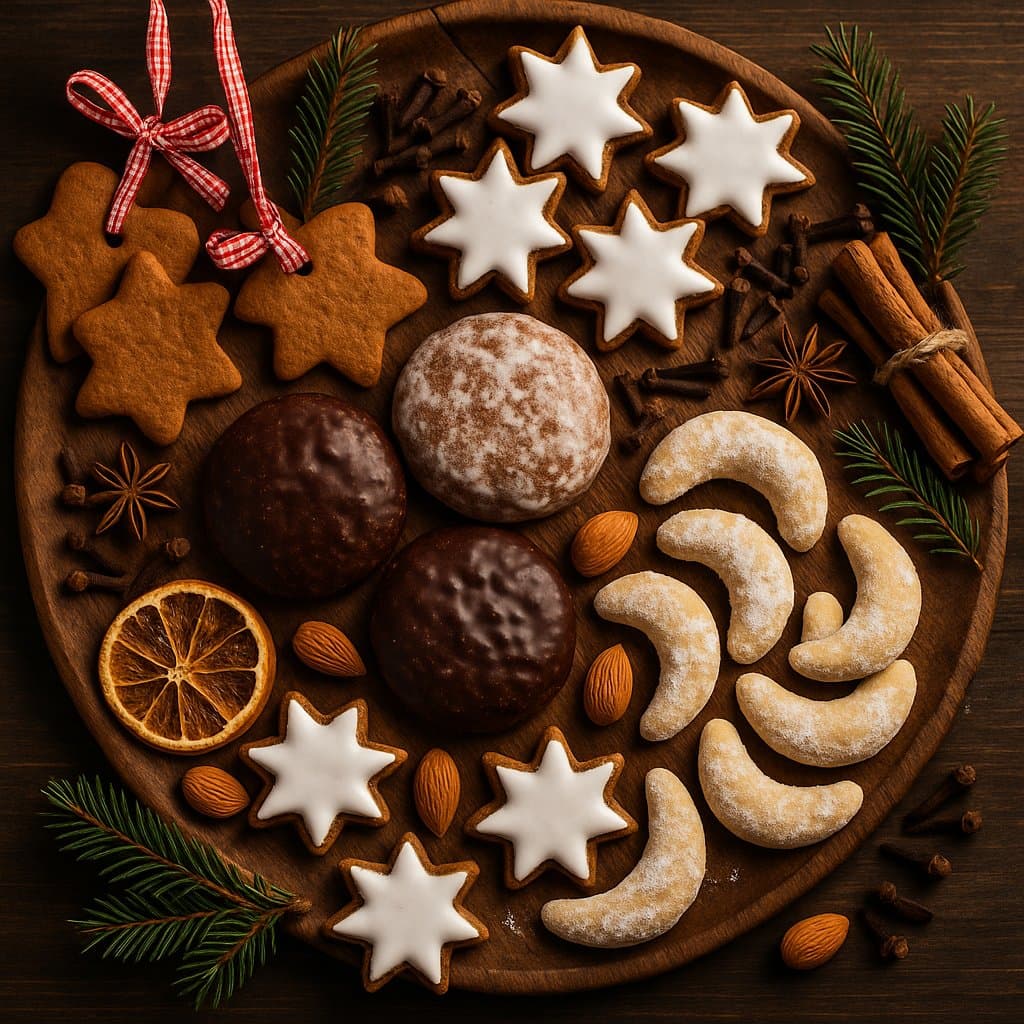
Nowhere did the Christmas cookie flourish more than in Europe. In Germany, Lebkuchen—soft, spiced honey cakes—were being made by guild bakers in Nuremberg as early as the 13th century. These richly flavoured treats used almonds, candied citrus peel, and exotic spices brought in by merchant ships. Some were baked on communion wafers; others were pressed into elaborate wooden moulds to create images of saints or festive symbols.
Austria gave us Vanillekipferl, delicate crescent-shaped cookies made with ground nuts and dusted in vanilla sugar. Their shape is said to commemorate the moon symbol of the defeated Ottoman Empire—though the story may be more legend than fact. In Switzerland and southern Germany, Zimtsterne—cinnamon stars—sparkled on Christmas tables, their snowy meringue glaze capturing the magic of the season.
In Scandinavia, cookies reflected the Nordic love for warmth and winter ritual. Swedish Pepparkakor, crisp gingerbread biscuits cut into hearts and stars, were often strung on ribbons and hung on trees. Norway brought Krumkake—wafer-thin cones pressed in patterned irons—and Sandbakelse, almond-scented cookies baked in fluted tins. In Finland, spiced Piparkakut became a festive staple, often shaped into reindeer, houses, or angels.
Across Central and Eastern Europe, families passed down their own cherished recipes: Hungary’s walnut crescents, Poland’s buttery Kruszczyki, Greece’s honey-drenched Melomakarona, and Sicily’s fig-filled Cuccidati—each bake carrying the memory of place and people.
Crossing Oceans and Changing Times
As Europeans migrated to the New World, they carried these recipes in memory and manuscript. German and Dutch settlers brought wooden biscuit moulds, gingerbread men, and butter-rich doughs. In Pennsylvania, Moravian Church communities baked spice cookies so thin they were almost translucent, flavoured with molasses and black pepper.
These immigrant traditions took root in American soil, where Christmas was still taking shape as a family-centred celebration. The rise of industrialisation in the 19th and 20th centuries gave home bakers access to affordable sugar, metal cookie cutters, printed cookbooks, and colourful tins. German moulds were widely imported between 1871 and 1906, standardising festive shapes like angels, bells, and trees.
It was during this time that the cookie became a cultural icon. Baking became not just a tradition, but an event—especially for children. By the 1930s, the American custom of leaving cookies and milk out for Santa Claus took hold. Rooted partly in European practices of gift-giving and generosity, it was also shaped by the hardship of the Great Depression. Parents encouraged children to give even in lean times, and cookies became a small, sweet symbol of kindness.
A Sweet Thread Through Centuries
Though ingredients and shapes may differ, the heart of the Christmas cookie remains the same. It is a symbol of generosity, of warmth, of taking time to make something by hand and share it with others. Whether it’s a star-shaped spice cookie from Sweden, a crescent from Vienna, or a sugar-dusted snowball from Mexico, these festive bakes carry centuries of history in every bite.
They are edible time capsules—bearing the memory of ancient feasts, medieval markets, ocean crossings, and holiday kitchens filled with laughter. To bake a Christmas cookie is to join that lineage. One tray at a time, we pass on the comfort, creativity, and quiet joy that have travelled with us through generations.
Ready to bake like it’s the 1600s? Try our traditional gingerbread cookies recipe here and bring a piece of Christmas history into your kitchen.