Each October, ovens warm across the world to prepare ghost-shaped cookies, pumpkin muffins, and eerie cupcakes. Halloween baking has become a beloved seasonal ritual — yet beneath the sugar and sprinkles lies a deep-rooted history shaped by ancient beliefs, religious practices, and evolving customs.
Let’s trace the story of Halloween baking from its earliest beginnings to the playful treats we enjoy today.
It Began with Samhain
The origins of Halloween can be traced back over 2,000 years to Samhain (pronounced “sow-in”), the ancient Celtic festival marking the end of harvest and the beginning of winter — often referred to as the “darker half” of the year. Celebrated in present-day Ireland, Scotland, and parts of northern France, Samhain was believed to be a time when the veil between the living and the dead was thinnest.
People left food offerings on doorsteps or near sacred trees and fires to appease wandering spirits and departed ancestors. These offerings weren’t yet baked goods as we know them, but they laid the groundwork for a connection between food and the supernatural — a central theme in Halloween customs.
Fires were extinguished at home and relit from large communal bonfires, and people dressed in animal skins and masks to ward off malevolent beings. It was a liminal moment of both fear and festivity — and food played a quiet but crucial role.
All Hallows’ Eve and the Rise of Soul Cakes
As Christianity spread across Europe, Samhain was gradually absorbed into the Church calendar. By the 8th century, 1 November was declared All Saints’ Day (also called All Hallows’ Day), and the evening before became All Hallows’ Eve — later shortened to Hallowe’en.
In medieval England, a custom called souling emerged. On All Hallows’ Eve and All Souls’ Day (2 November), the poor — often children — would go door to door offering prayers for the souls of the departed in exchange for food. In return, they received soul cakes.
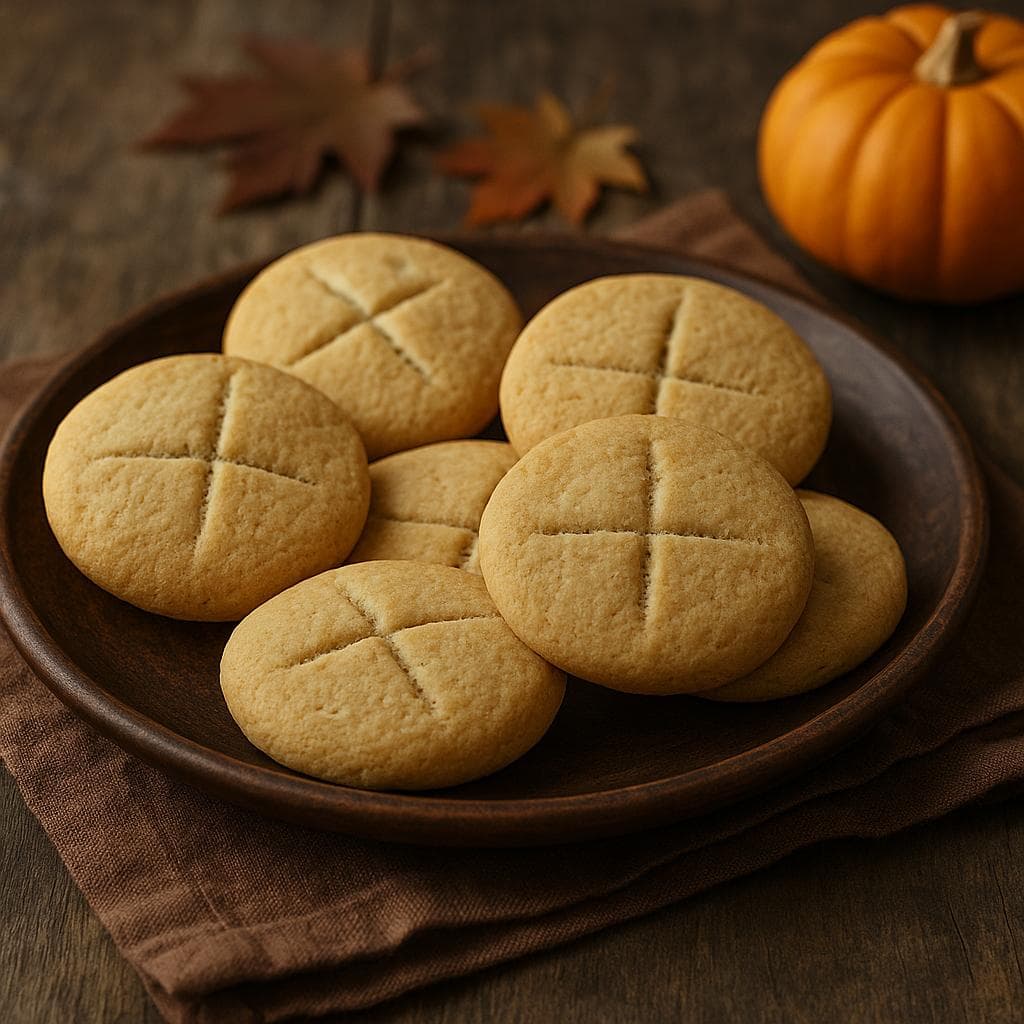
Soul cakes were small round cakes, lightly spiced and sometimes dotted with currants or raisins. They often bore a cross on top and symbolised a prayer for the dead. The phrase “a soul for a soul cake” echoed through towns and villages, blending Christian charity with earlier Celtic ideas of appeasing spirits.
In some areas, families would leave soul cakes on the table overnight for visiting spirits. The link between food and the afterlife remained strong — and this practice is one of the earliest recorded traditions resembling modern trick-or-treating.
Barmbrack and the Ritual of Fortune-Telling
In Ireland, another Halloween tradition developed alongside souling: barmbrack, a sweet, yeasted fruit bread baked with charms hidden inside.
Each charm held symbolic meaning:
A ring predicted an impending marriage
A coin foretold wealth
A pea or bean meant poverty
A stick warned of disputes
A cloth or rag signified bad luck
Sliced and shared at Halloween gatherings, barmbrack turned baking into an act of divination, echoing the spiritual uncertainty and curiosity of Samhain. The bread wasn’t merely a dessert — it was a mirror into one’s future.
This blend of fun and superstition, sweetened with dried fruit and shared with family, marked barmbrack as a uniquely Irish Halloween tradition. It continues to this day, especially among Irish diaspora communities.
Halloween Crosses the Atlantic
Irish and Scottish immigrants brought their Halloween customs — including souling and barmbrack — to North America in the 19th century. These customs mingled with local harvest festivals and eventually evolved into the secular, family-friendly Halloween we know today.
The emphasis shifted from the spiritual to the playful, and baking became central to the celebration:
Pumpkins, native to the Americas, replaced turnips for carving and also found their way into pies and cakes.
Candy became commercialised, but home bakers embraced the season with ghost-shaped cookies, spider cupcakes, and black-and-orange frosted treats.
In the 20th century, women’s magazines and cookbooks popularised Halloween party foods for children — often sweet, silly, and decorative.
The serious symbolism of earlier times gave way to festivity and fun, but the idea of baking to mark a threshold — between seasons, between worlds — remained.
What Modern Halloween Baking Still Carries
Today’s Halloween baking often looks far removed from its origins. We bake marshmallow ghosts, black velvet cupcakes, candy-stuffed cookies, and pumpkin-flavoured everything. But if we look closer, the threads of tradition are still there:
Baking as an act of remembrance
Sweet food shared in community
Symbolic meanings hidden in recipes
A mix of the eerie, the hopeful, and the comforting
In some ways, every Halloween cookie we shape or cake we carve is a quiet echo of ancient fires and whispered prayers.
Whether you’re looking to connect with tradition or just serve up something spooky and sweet, Halloween baking has a story worth telling — and tasting.