There is a cake most people have eaten countless times, yet rarely stop to consider. It appears at birthdays, afternoon teas, and in bakeries across the world. It forms the base of layered celebration cakes, Swiss rolls, and simple home bakes alike. And yet, it often goes unnoticed.
This is the sponge cake.
What makes it remarkable is not how it looks, but how it works. Long before baking powder became a standard ingredient, sponge cakes relied on a far more delicate method: air. Eggs and sugar were beaten together until pale and voluminous, trapping air within the mixture. When baked, that air expanded, giving the cake its rise. Flour was then folded in carefully to preserve that structure. No chemical leavening was needed.
This technique has roots that reach back to the early modern period of European baking. By the 16th century, recipes resembling sponge cakes were already appearing in Italian culinary texts.
One of the most frequently cited early examples is found in the work of Bartolomeo Scappi, chef to Pope Pius V, whose 1570 cookbook Opera dell’arte del cucinare includes preparations for light cakes made with whipped eggs and sugar. These early forms were not identical to modern sponge cakes, but they reveal an emerging understanding of how air could be incorporated into mixtures to create a lighter texture.
From these beginnings developed what is now known as the Genoise, associated with the city of Genoa. By the 17th and 18th centuries, this style of cake had become established across parts of Europe.
Genoise relies entirely on the mechanical aeration of eggs, sometimes enriched with a small amount of butter, but always defined by its fine, elastic crumb. Its success depended not on chemical agents but on the baker’s ability to control temperature, timing, and technique.
In England, a related form appears in the 18th century under the name “sponge cake.” A notable reference can be found in Hannah Glasse’s The Art of Cookery Made Plain and Easy, first published in 1747, where a recipe titled “To Make a Fine Sponge Cake” calls for eggs, sugar, and flour, beaten and baked without yeast. This is one of the earliest clear English examples of a sponge cake in recognisable form.
By the 19th century, sponge cake had begun to shift from a technical preparation to a domestic staple. The introduction and wider availability of chemical leavening agents, particularly baking powder in the mid-1800s, changed the nature of cake-making. Recipes became more forgiving, and cakes could be produced with greater consistency, even without precise technique.
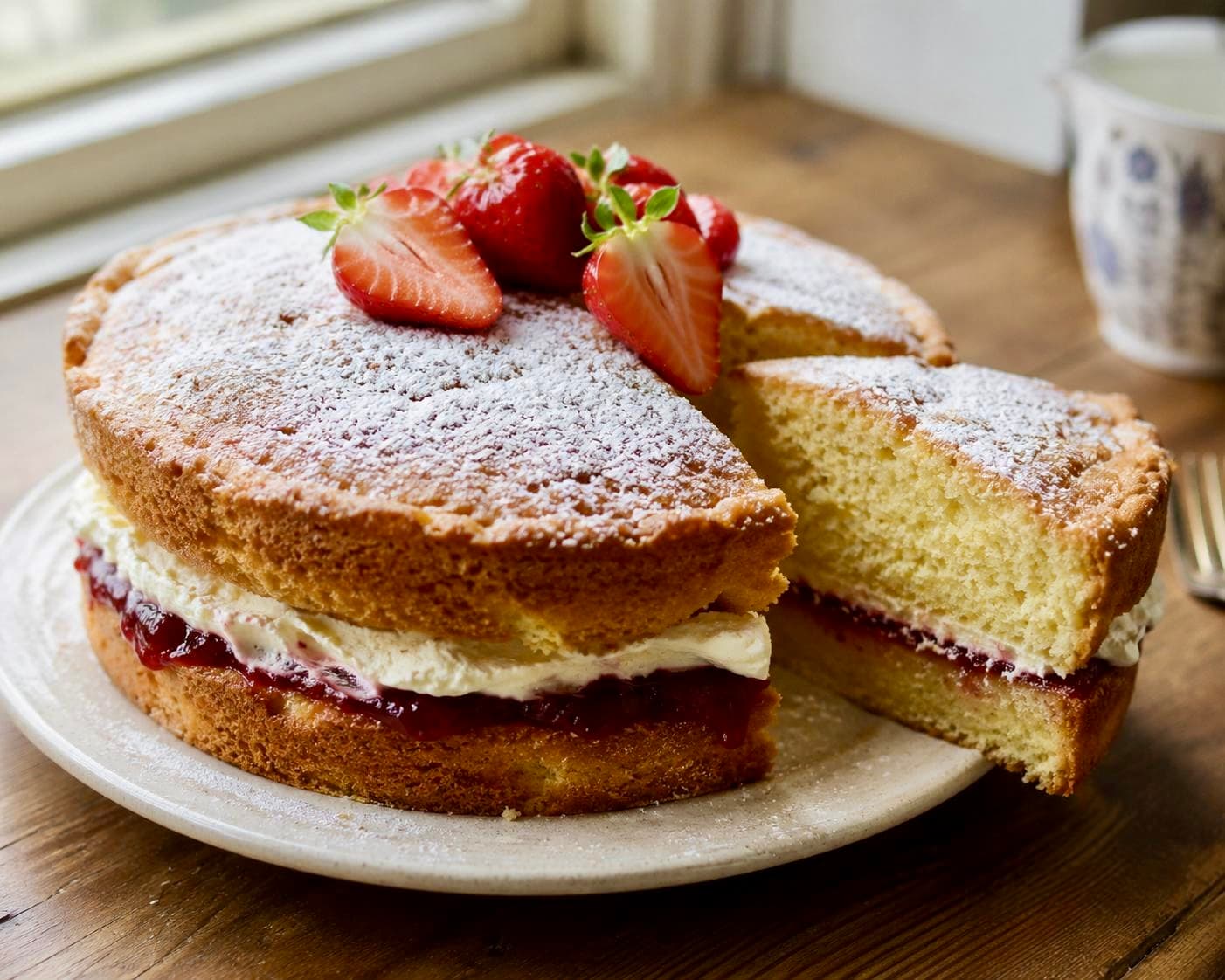
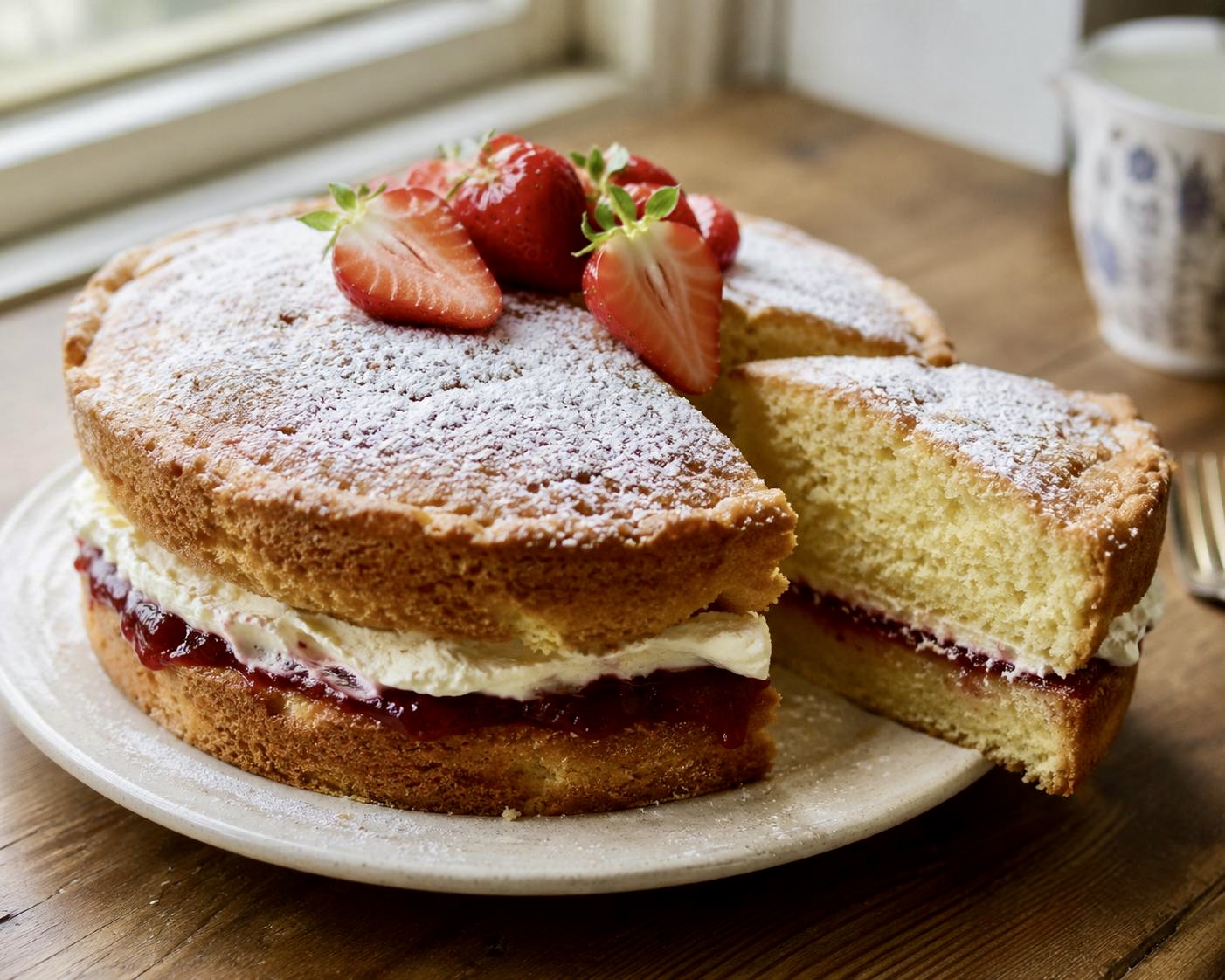
It was during this period that sponge cake took on one of its most familiar forms in Britain: the Victoria sponge, closely associated with Queen Victoria. Unlike earlier sponge cakes, this version incorporated butter, creating a richer and more tender crumb. Filled with jam, and later cream, it became a defining element of afternoon tea — a social ritual that shaped British baking traditions.
By the late 19th century, it was no longer a specialised bake, but a standard part of home cooking. One of the best-known expressions of this tradition is the Victoria sponge — explore its story in Victoria Sponge: The History of the Queen’s Favourite Cake. For a broader look at how these rituals developed, see The Origins of Afternoon Tea.
What makes this evolution significant is not just the recipe itself, but what it represents. Sponge cake began as a demonstration of technique — a careful balance of air, structure, and timing. Over time, it became a foundation. Many of the cakes we recognise today, from layered celebration cakes to roulades and filled sponges, are built upon this same principle.
And yet, because it is so familiar, it is easy to overlook.
Sponge cake does not demand attention in the way elaborate or highly decorated cakes do. It is quiet, adaptable, and often taken for granted. But in many ways, it is one of the most important developments in the history of baking — a bridge between early culinary skill and modern home baking.
If you have read our article on the Victoria sponge, you will already recognise one version of this story. But that familiar cake is only one chapter in a much longer history — one that begins with nothing more than eggs, sugar, flour, and air.
If you would like to experience this tradition firsthand, here is our Classic Victoria Sponge Cake Recipe.