
The History of Strawberries in Cakes
Strawberries appear in cakes across cultures in a way few other fruits do.
From Japan’s delicate celebration cakes to Finland’s summer mansikkakakku, from Norway’s bløtkake to Britain’s strawberries and cream, the pattern is unmistakable: wherever there is cake, strawberries are never far behind.
But this is not simply a matter of taste.
The rise of strawberries in cakes can be traced through cultivation, early European dessert traditions, and the gradual development of sponge-based cakes in the 18th and 19th centuries. Their presence today is the result of a very specific historical convergence.
From Wild Forest Fruit to Cultivated Ingredient
Before strawberries entered baking, they existed primarily as wild fruits. The most common variety in Europe, Fragaria vesca, produced small, intensely aromatic berries that were gathered rather than farmed. These berries appeared in medieval texts and herbals, but rarely in structured desserts.
Cultivation began in France during the 16th and 17th centuries, where strawberries were transplanted from forests into royal and monastic gardens. However, these early cultivated forms remained small and inconsistent, limiting their culinary use.
A decisive shift occurred in the mid-18th century. Plants of Fragaria virginiana from North America and Fragaria chiloensis from South America were brought to Europe and grown together, particularly in France. Their natural hybridisation produced Fragaria × ananassa, the modern garden strawberry.
This new fruit was larger, juicier, and more stable in flavour. It could be sliced, layered, and combined with other ingredients in ways that earlier strawberries could not.
Without this botanical development, strawberry cakes would not have been possible.
The Precursor: Strawberries and Cream in Early England
Long before strawberries appeared in cakes, they became established in a simpler form.
Strawberries served with cream.
This pairing was documented in England by the 16th century and is often associated with the court of Henry VIII. At a time when sugar was costly and desserts were not yet formalised into layered structures, strawberries paired with cream provided a complete and balanced dish.
Its importance lies in that balance. Strawberries introduced brightness and acidity, while cream provided richness and body. Together, they created a contrast that would later underpin many European desserts.
By the 18th century, strawberries and cream had become a recognised seasonal dish in Britain, particularly in early summer. This association with seasonality and celebration persisted, later reinforced by traditions such as Wimbledon.
When cakes began incorporating strawberries, they did not create a new flavour combination. They adapted one that was already well established.
The Emergence of Strawberry Cakes in 18th–19th Century Europe
The appearance of strawberries in cakes followed the development of sponge-based baking.
Prior to the 18th century, most European cakes were dense, bread-like, or heavily spiced. The introduction of lighter sponge cakes, particularly genoise and whisked sponge, created a structure capable of supporting cream and fresh fruit.
By the late 18th and early 19th centuries, layered cakes began to emerge in France and Britain, incorporating cream and fruit fillings. While exact “first recipes” for strawberry cakes are difficult to attribute to a single source, cookbooks from this period began including fruit-filled sponge cakes and early forms of shortcake.
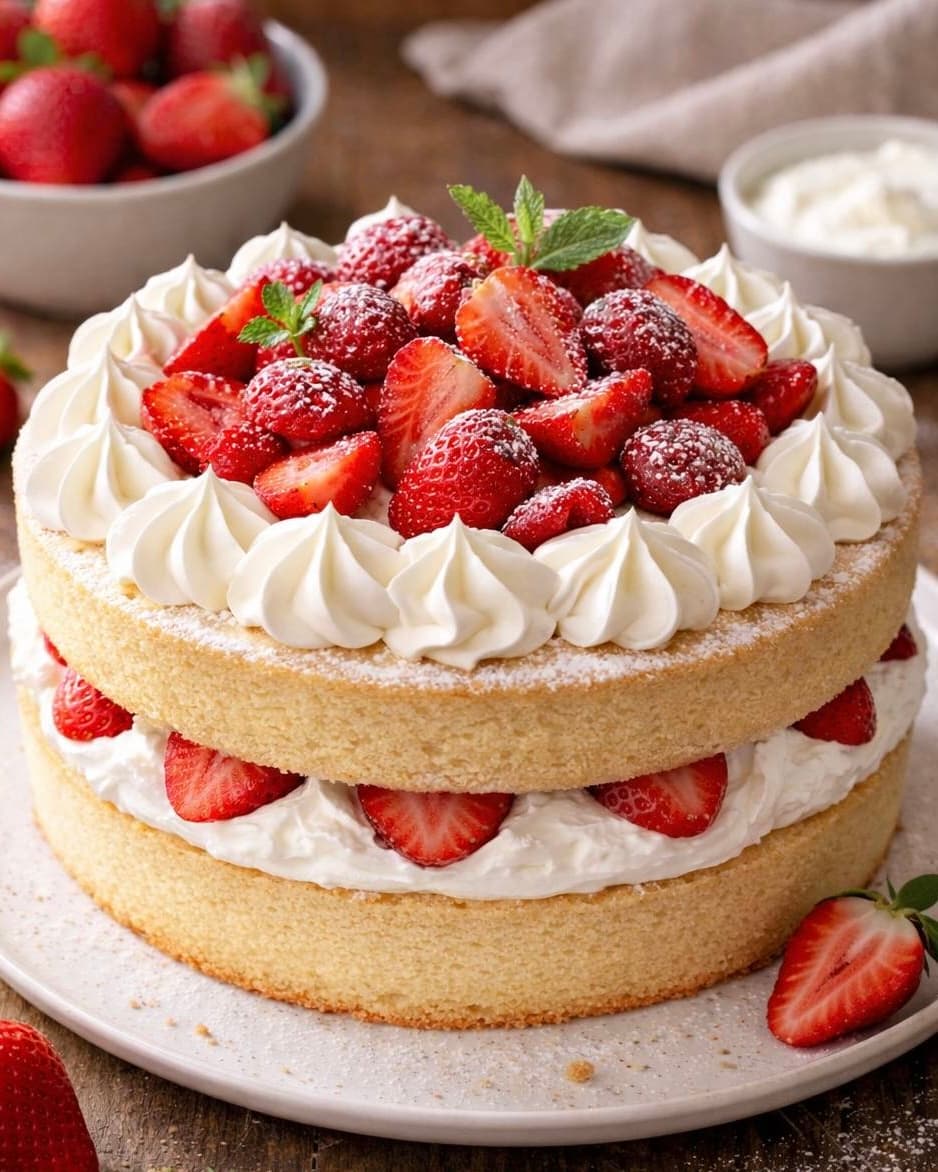
In Britain, this evolution contributed to cakes such as the Victoria sponge, where strawberries and cream became a defining filling.
In parallel, versions of strawberry shortcake developed in both Britain and North America during the 19th century, combining biscuit or sponge bases with cream and fresh strawberries.
At this point, the elements had aligned.
The fruit had been stabilised through cultivation. The pairing with cream was already established. The structure of cakes had evolved to support both.
Strawberry cake, in its modern sense, became possible.
A Fruit That Adapted Across Cultures
Once established in European baking, strawberries moved easily across cultures, adapting to local traditions while maintaining the same structural role.
In Japan, strawberries were introduced during the Meiji period alongside Western-style baking. By the 20th century, they became central to the modern Christmas cake — a light sponge layered with whipped cream and strawberries. The dessert reflects both Western influence and Japanese precision, with strawberries serving as both flavour and visual focus, as seen in our Japanese Strawberry Shortcake Recipe accompanying The Origins and History of Strawberry Shortcake article.
In Finland, strawberries are closely tied to the short summer season, particularly around Midsummer celebrations. Cakes such as mansikkakakku rely on freshly harvested berries at their peak, reflecting a tradition shaped by seasonality and local availability. This is explored in our Mansikkakakku Recipe accompanying Celebrating Midsummer with Finnish Strawberry Cake article.
In Norway, bløtkake follows a similar structure but reflects a broader Scandinavian tradition of layered sponge cakes with cream and berries, shaped by earlier Danish and German baking influences. By the late 19th to early 20th century, it had become established as a celebration cake, often featuring strawberries in summer, as seen in our Norwegian Cream Cake (Bløtkake) Recipe accompanying Norwegian Cream Cake: A Slice of Celebration article.
In Britain, strawberries became closely associated with summer desserts through the long-standing pairing of strawberries and cream, later evolving into dishes such as Eton mess. Traditionally linked to Eton College in the late 19th century, this dessert combines strawberries, cream, and meringue in a form that is less structured but rooted in the same flavour balance. This is captured in our Eton Mess Recipe accompanying Eton Mess: A Sweet British Classic Born from Chaos article.
Across all these examples, strawberries perform the same function. They are not decorative additions. They define the cake itself.
From Seasonal Ingredient to Global Availability
For much of their history, strawberries were limited by season and geography. Their fragility meant they were consumed close to where they were grown.
Modern agricultural practices, including controlled cultivation and improved transport, expanded their availability. Strawberries could now be grown at scale and distributed widely, allowing strawberry cakes to move beyond their original seasonal context.
Even so, their strongest cultural associations remain tied to early summer and celebration, reflecting their historical origins.
Why Strawberries, Specifically
The dominance of strawberries in cakes can be traced to a convergence of factors rather than a single reason.
Botanically, the development of Fragaria × ananassa made them suitable for slicing and layering. Culinarily, the established pairing with cream provided a ready-made flavour structure. Technically, the emergence of sponge cakes created a suitable base.
Visually, strawberries offered contrast and clarity. Seasonally, they aligned with periods of celebration.
Other fruits entered baking through different paths. Strawberries entered at a moment when all these elements were already in place.
Why Strawberries Endured in Cakes
Strawberries became the world’s favourite cake fruit through a sequence of developments rather than a single invention.
They moved from wild forest berries to cultivated crops, from simple pairings to structured desserts, and from seasonal delicacies to global ingredients.
By the time cakes were ready to incorporate them, strawberries were already perfectly suited to the role.
And across cultures, that role has remained remarkably consistent.
Affiliate Disclosure: This article may contain affiliate links. When you purchase through these links, we may earn a commission at no additional cost to you. This helps support our content creation.