Around the World in 80 Bakes: Stop #50 — Petit Fours
Petit fours may feel like a refined detail of French pastry.
Small, precise, and often delicately finished, they appear closely tied to formal dining and elegant presentation.
But the idea behind petit fours is far older than it seems. Long before they became associated with French patisserie, bakers were already creating small-scale cakes — not for aesthetics, but shaped by practicality, technology, and changing social habits.
What has changed is not the concept, but the intention.
To understand the origins of petit fours, it is necessary to look beyond their size and trace how baking itself evolved — from large, communal preparations to the carefully portioned forms we recognise today.
Before Petit Fours: When Cakes Were Shared, Not Individual
The earliest recorded cakes in ancient civilisations were not small.
In ancient Greece, cakes such as plakous — flat, honey-sweetened bakes made with flour and cheese — were prepared as offerings and shared among groups. Similarly, in ancient Rome, early cakes were dense, bread-like preparations made from wheat, honey, and nuts, often baked as a single large piece intended for communal consumption.
Even as baking techniques improved through the Middle Ages, cakes remained large and symbolic. Fruit cakes, spice cakes, and early celebratory bakes were designed to serve many people at once. They were cut, divided, and distributed, reinforcing the idea that cake was something to be shared.
The concept of a cake made for one person did not yet exist in any meaningful way.
The First Shift: Individual Cakes in Early European Baking
The transition towards smaller cakes begins to appear more clearly in early modern Europe, particularly from the 17th century onwards.
One of the earliest documented examples of small, individual cakes can be found in English baking. The term “cake” itself begins to branch into smaller forms such as “tea cakes” and “little cakes” in written recipes. In The Queen-like Closet by Hannah Woolley, published in 1670, there are references to small, individually portioned baked goods served alongside tea. While these were not “mini cakes” in the modern sense, they represent an early shift towards baking in smaller portions for individual consumption.
By the 18th century, this idea develops further in British and European kitchens, where small sponge-based cakes begin appearing in domestic baking. These cakes were often baked in small moulds or shaped by hand, reflecting both technological limitations and changing dining habits.
At the same time, improvements in refined sugar production allowed for lighter batters and more delicate cakes. This made it possible to produce smaller cakes that were structurally sound yet soft and tender, signifying an important step in the evolution of mini cakes.
France and the Defining Moment: The Rise of Petit Fours
The most decisive turning point in the history of mini cakes comes from France in the 18th and 19th centuries with the emergence of the Petit four.
The term petit four, meaning “small oven,” originates not from size, but from baking technique. In large wood-fired ovens, bakers would first bake bread at high heat. Once the fire died down, the residual heat in the oven — known as à petit four — was used to bake smaller, more delicate items.
What began as a practical use of residual heat soon developed into a defined category within French pastry.
By the late 18th and early 19th centuries, petits fours were no longer defined solely by how they were baked, but by how they were prepared, classified, and served. French pastry kitchens distinguished between several types, reflecting both texture and purpose.
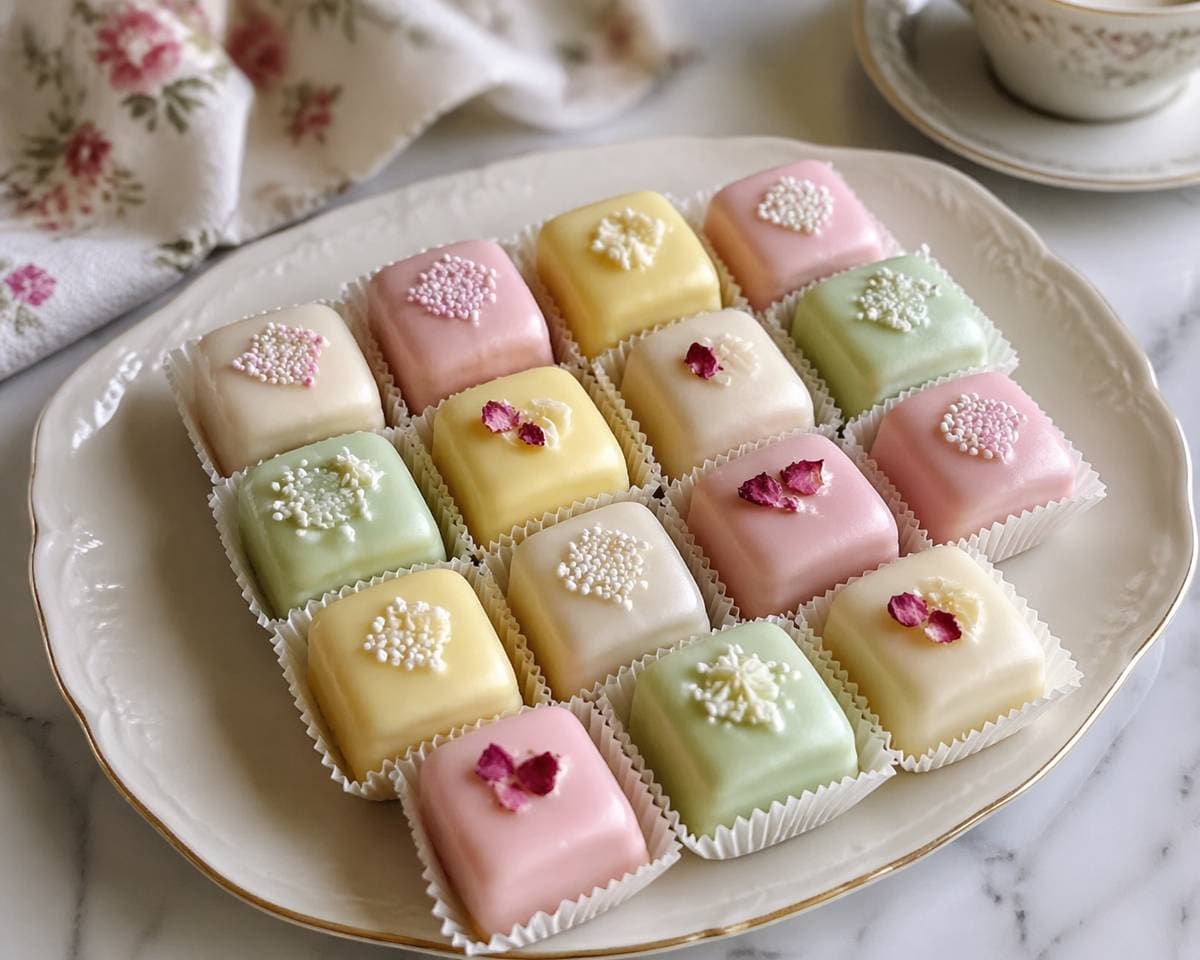
Petits fours glacés were the closest to what we would recognise today as mini cakes. These were small, layered sponge cakes, often filled with jam, buttercream, or ganache, then coated in poured fondant or glaze. They were cut with precision into uniform shapes — squares, rectangles, or diamonds — and finished with decorative piping or icing.
Alongside these were petits fours secs, which included small dry biscuits, shortbread, and meringues, and petits fours frais, referring to fresh, delicate pastries such as miniature éclairs or tartlets that required refrigeration and were served shortly after preparation.
This classification reveals a clear shift.
By this stage, petits fours were no longer simply a way to use leftover heat — they had become an integral part of structured dining.
They were typically served at the end of a meal, often with coffee or liqueurs, allowing guests to sample a variety of small, refined sweets rather than a single large dessert. Their size made them particularly suited to social settings, where ease of serving and elegance of presentation were equally valued.
By the early 19th century, French culinary texts and professional pastry practices had formalised these small cakes as part of high-end service. The influential chef Marie-Antoine Carême, often regarded as one of the founders of modern haute cuisine, helped elevate pastry into an architectural art form. Under this tradition, small cakes became refined, precise, and visually composed, reflecting the broader aesthetics of French culinary design.
Miniature cakes were no longer simply practical. They were intentional, designed, and sophisticated.
From Aristocratic Tables to Social Dining
By the 19th century, small cakes had become deeply associated with elite European dining culture.
In France and later in Britain, miniature cakes were served at the end of formal meals or as part of afternoon tea. Their small size made them particularly suited to social settings where guests stood, conversed, and ate without the need for slicing or serving utensils.
This shift reflects a broader change in dining culture.
Food was no longer only about sustenance or ceremony — it was about experience.
Mini cakes allowed for precision in portioning, ease of serving, and a refined presentation that larger cakes could not easily achieve.
The idea of having one complete cake per person, rather than a slice from a larger one, begins to take hold here.
19th to Early 20th Century: Technology Enables Miniature Baking
The widespread adoption of metal cake tins in the 19th century, along with improvements in enclosed domestic ovens, quietly transformed the scale at which cakes could be made.
Earlier baking had relied heavily on large, shared ovens and simple forms, where smaller cakes were often cut from larger ones. With the introduction of more controlled heat sources and purpose-made tins, bakers gained the ability to shape, portion, and bake cakes with far greater precision.
Small cakes no longer needed to be carved out of a larger bake. They could be formed from the beginning.
By the late 19th century, European and British recipe books increasingly include instructions for individually portioned cakes, buns, and sponge-based bakes. These were often prepared in small moulds or shallow tins, allowing for consistency in both size and texture.
Among the clearest examples of this shift is the rise of mould-specific cakes such as the madeleine (you can read more about the The History of Madeleines here). Traditionally baked in a distinctive shell-shaped pan, madeleines demonstrate an important development in baking history: cakes designed specifically for individual moulds rather than adapted from larger forms.
The madeleine pan itself allowed for uniform, small cakes to be baked quickly and evenly. This marked a clear departure from earlier methods, where cakes were divided after baking rather than formed individually from the outset.
Across Europe, similar approaches appeared in other forms, including small sponge cakes baked in individual moulds or shallow tins, alongside pastry preparations made in tartlet pans. These developments reflect a broader transition in baking, where portion size, shape, and presentation could be controlled from the outset.
This marks a key turning point. Mini cakes are no longer cut from larger cakes — they are conceived, shaped, and baked as individual units from the very beginning.
From Petit Fours to Modern Mini Cakes
Today’s mini cakes — whether layered, frosted, or styled as small celebration cakes — are not entirely new creations.
They are a synthesis of historical developments, including the communal cakes of ancient civilisations, the individual tea cakes of early European baking, the refined precision of French petit fours, and the practicality enabled by modern baking tools.
What has changed is the intention.
In the past, mini cakes emerged from necessity — heat management, resource efficiency, and technological limits.
Today, they are chosen deliberately. They offer a personalised experience, visual appeal, and flexibility in flavour and design.
In many ways, they reflect a return to craftsmanship on a smaller scale — where detail matters more than size.
From Necessity to Design
Mini cakes may appear to belong to the present, but they carry a lineage that stretches back centuries.
From the early “little cakes” of 17th-century England to the refined petits fours glacés of 19th-century France, the idea of a small, individual cake has evolved alongside changes in technology, society, and taste.
Modern mini cakes occupy a space between the delicate precision of petits fours and the scale of traditional celebration cakes. They are larger than a bite-sized pastry yet smaller than a shared centrepiece, and are conceived as complete, individual desserts that are layered, finished, and served with the same intention as their full-sized counterparts.
If you would like to see how this translates into practice, you can explore our Classic Petit Fours Glacés Recipe here.
What we see today is not a new invention, but a continuation.
A smaller cake, perhaps, but one shaped by centuries of adaptation, refinement, and changing ways of eating.