
Around the World in 80 Bakes: Stop #52 — Peach Cobbler
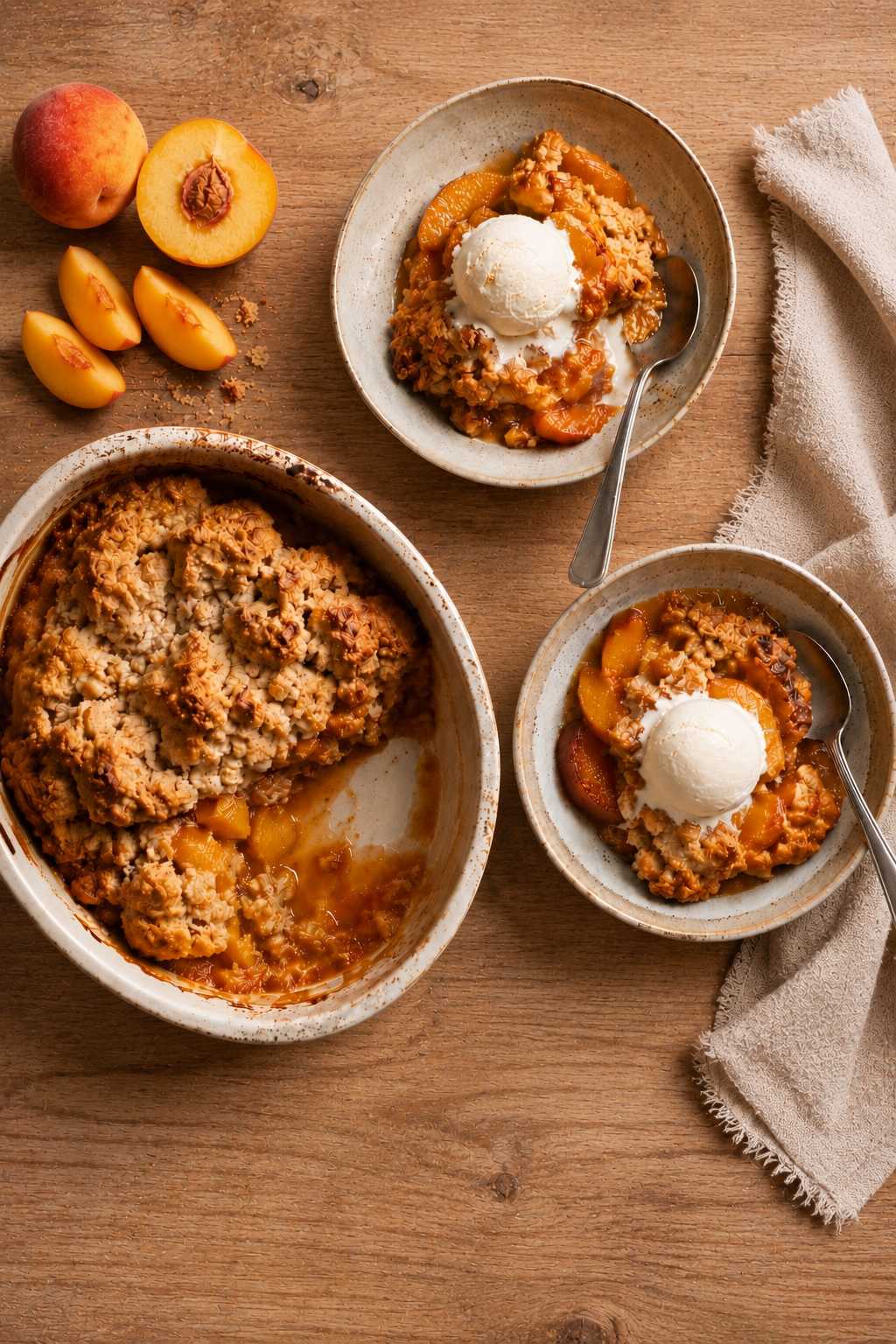
There is something unmistakably comforting about peach cobbler, with its bubbling fruit and golden topping, fresh from the oven. While it is most closely associated with the American South today, its roots lie in a broader story of migration and adaptation. Rather than emerging as a single defined recipe, peach cobbler developed gradually from British fruit puddings and pies, reshaped by the conditions of early colonial cooking.
18th Century: British Traditions in a New Setting
Cobbler developed from British fruit puddings and pies brought to North America by English, Scottish, and Irish settlers. These desserts typically relied on suet pastry, enclosed crusts, or steaming methods, and were prepared in controlled kitchen environments.
In the American colonies, those conditions were difficult to replicate. Ovens were unreliable or unavailable, and cooking was often done over open fires. Instead of forming structured pies, cooks placed fruit into deep pots or simple dishes and added a basic dough or batter on top.
As the topping baked, it formed uneven mounds rather than a smooth crust. The term “cobbler” is widely believed to refer to this rough, cobbled appearance.
Late 18th to Early 19th Century: A Practical Frontier Method
By the late 18th and early 19th centuries, cobbler had become a practical method rather than a fixed recipe.
It required fewer ingredients than pies, did not depend on precise pastry techniques, and could be prepared in cast-iron pots or Dutch ovens over hot coals. The fruit softened below while the topping baked unevenly above, creating a dessert that was functional rather than decorative.
Different regions used different toppings, including biscuit dough, dumplings, or simple batters. This variation reflects its origins as a flexible approach to baking.
19th Century: Peaches and the Southern Landscape
Cobbler became closely associated with peaches in the 19th century, particularly in the American South.
Peaches originated in China and spread westward along trade routes through Persia, where they became established before reaching Europe. From there, they were introduced to North America by European settlers. They adapted particularly well to the Southern climate, where orchards expanded across states such as Georgia and South Carolina.
Because peaches were abundant during summer and highly perishable, baking them into cobblers provided an efficient way to use the fruit. Over time, peach cobbler became the most recognised variation.
Early cookbook references confirm the dish’s presence. The Kentucky Housewife by Lettice Bryan, published in 1839, includes recipes for fruit cobblers, indicating that the method was already established.
19th Century: African American Influence
Cobbler was further shaped in Southern kitchens, where enslaved African American cooks played a central role in food preparation.
Working within constrained conditions, they adapted European techniques to local ingredients and cooking methods. Cobbler suited these environments: it could be made in large quantities, required simple ingredients, and worked well in cast-iron cookware.
Many elements associated with Southern cobbler traditions today were refined in these kitchens and preserved through generations.
Early 20th Century: From Regional Dish to Household Standard
By the early 20th century, peach cobbler had become part of American home baking.
Improved domestic ovens and the availability of canned peaches made the dessert more accessible and consistent. Recipes appeared more widely in cookbooks and community collections, although variation remained common.
Cobbler continued to be defined by its adaptability rather than strict rules.
Mid-20th Century: Cultural Identity
During the mid-20th century, peach cobbler became closely tied to Southern identity and home cooking.
It was commonly served at gatherings and seasonal meals, reinforcing its role as an informal, shared dessert. Efforts to promote peach farming, particularly in Georgia, further strengthened the association between peaches and cobbler.
Today: A Flexible, Enduring Dessert
Peach cobbler remains widely recognised because it retains its original qualities. It is simple, adaptable, and does not depend on precision.
There is still no single standard version. Some recipes use biscuit toppings, while others use batter that forms a softer, cake-like layer. This variation reflects its origins as a method shaped by available ingredients and conditions.
A Method Shaped by Adaptation
Peach cobbler did not begin as a fixed recipe, but as an adaptation of British fruit puddings and pies to the realities of early American cooking.
Its development reflects the movement of people, the availability of ingredients, and the practical demands of cooking in new environments. Over time, it became associated with Southern peaches and regional traditions, while retaining the flexibility that defined it from the beginning.
If you are interested in how traditional bakes evolve through adaptation and local ingredients, you may also explore our articles on The Curious History of Apple Pie and The History and Origins of Pineapple Upside-Down Cake.
If you would like to experience this dessert as it is made today, you can find our Classic Peach Cobbler Recipe here.