Around the World in 80 Bakes: Stop #62 — Basque Cheesecake
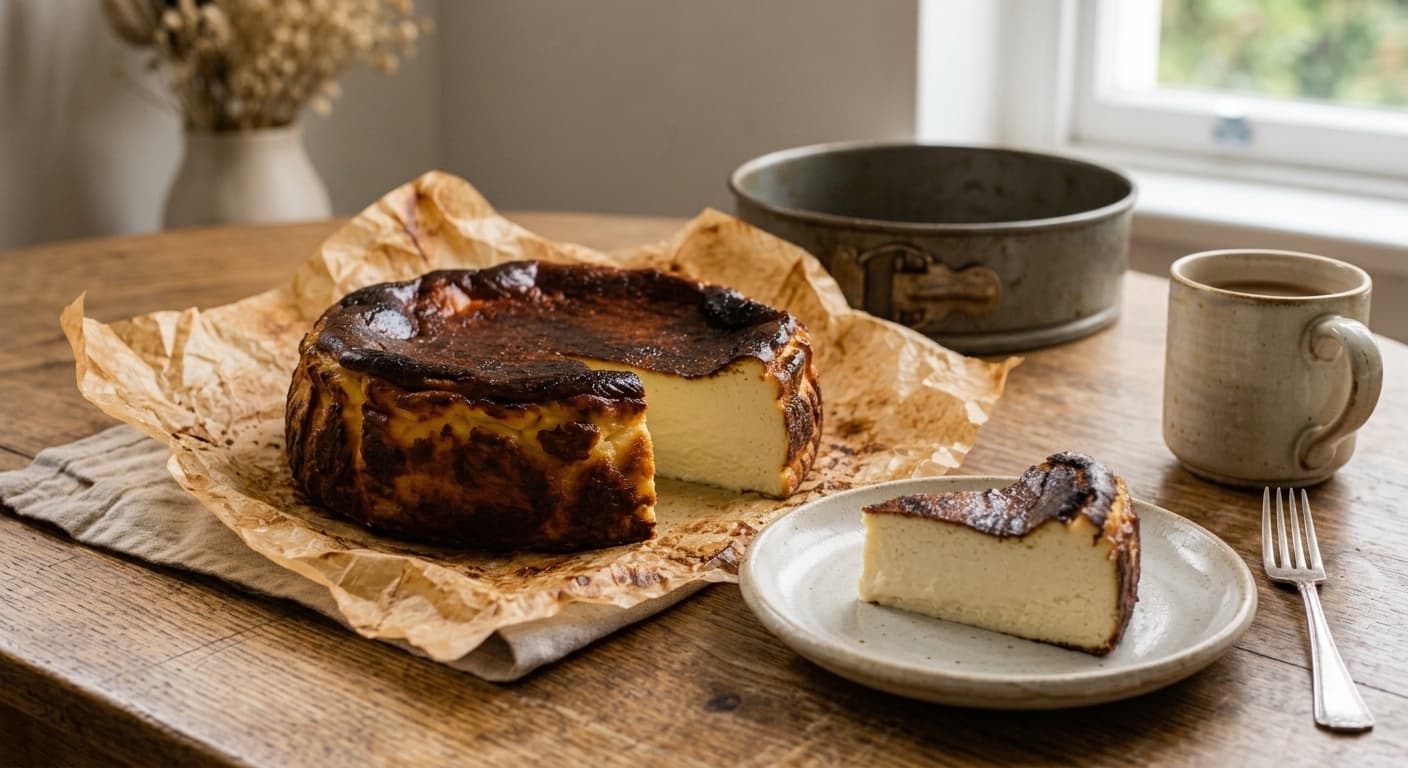
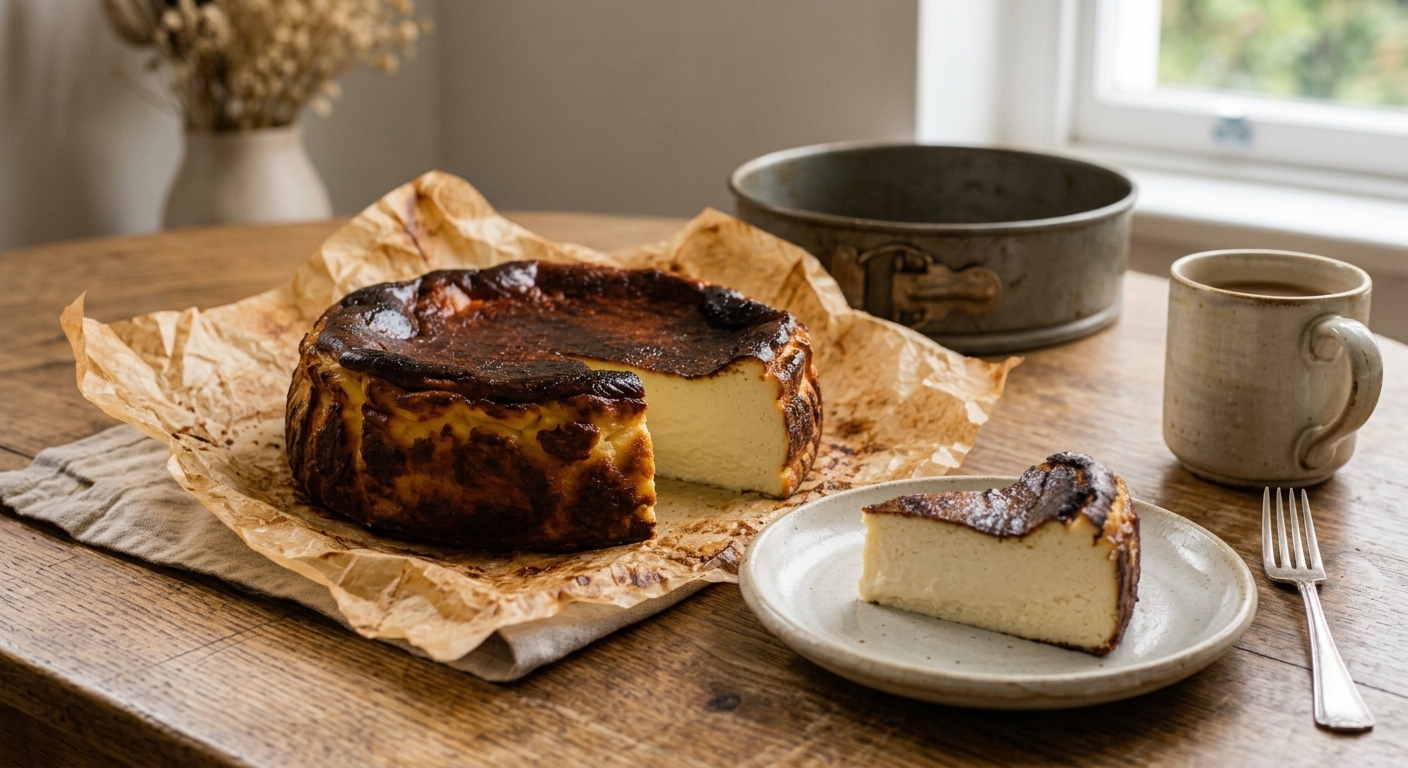
With its deeply browned surface, sunken centre and crumpled paper sides, Basque cheesecake looks strikingly different from a conventional cheesecake. It has no biscuit crust or smooth ivory top. Instead, it is baked at a high temperature until the outside becomes dark and toasted while the centre remains soft and creamy.
Despite its name, this is not an ancient regional speciality passed down through generations. Its story began surprisingly recently in a family-run restaurant in San Sebastián.
A Modern Cheesecake from the Basque Country
The dessert now known internationally as Basque cheesecake was created by Santiago Rivera at La Viña, a restaurant and pintxos bar in the Old Town of San Sebastián, known as Donostia in the Basque language.
La Viña was opened by Rivera’s parents and uncles in 1959. The establishment initially served simple food alongside wine, including freshly landed anchovies, before developing into a traditional restaurant and classic Donostia pintxos bar.
When Rivera became involved in its kitchen, he decided to develop a dessert for the menu. He looked through cookery books for inspiration, chose cheesecake and began experimenting with different proportions in 1987. His aim was to create a cake with a pronounced cheese flavour and an especially creamy texture.
After three years of trials, Rivera placed the finished tarta de queso on La Viña’s menu in 1990.
Five Simple Ingredients
Rivera’s recipe uses only five ingredients: cream cheese, cream, eggs, sugar and a small amount of flour. The mixture is poured into a tin lined with large sheets of baking paper and baked without a biscuit base.
The intense oven heat causes the surface to brown rapidly, creating toasted and caramel-like flavours while the tall centre remains soft and trembling. The roughly folded paper produces the irregular sides that have become part of the cake’s recognisable appearance.
As it bakes, the cheesecake rises dramatically before sinking as it cools. Its creased edges, cracked surface and lowered centre are not faults but natural results of the method.
The original La Viña cheesecake is generally deeply golden or toasted rather than completely black. Some later interpretations are baked until the surface becomes considerably darker, producing a stronger contrast between the slightly bitter exterior and the rich, sweet filling.
The Cheesecake of La Viña
At La Viña, the dessert was simply the restaurant’s house cheesecake: tarta de queso de La Viña. It was not originally presented as a distinct category of Basque baking.
Its reputation grew gradually as visitors discovered it while exploring San Sebastián’s pintxos bars. The cheesecake became a popular stop on food tours, and travellers returned home eager to recreate it.
Rivera never treated the recipe as a closely guarded secret. He shared its ingredients openly and, around 2008 or 2009, distributed recordings showing how some of La Viña’s dishes were prepared.
He also accepted that cooks would adjust the recipe to suit their tastes. Vanilla, salt and lemon zest appeared in later versions, although La Viña continued to serve its cheesecake plain so that the flavour of the cheese remained prominent.
Why Is It Called Burnt Basque Cheesecake?
The name “burnt Basque cheesecake” became common after the dessert travelled outside Spain. Its dramatically browned surface made the description memorable, particularly when compared with the paler cheesecakes familiar in Britain and the United States.
In San Sebastián, however, it is more closely associated with its place of origin and known as tarta de queso de La Viña. The word “burnt” largely belongs to the cake’s international identity.
The name “Basque cheesecake” can also suggest that it is a historic speciality made throughout the Basque Country. It is more accurately understood as a modern San Sebastián creation born within the region’s celebrated food culture.
How Basque Cheesecake Travelled Around the World
For many years, La Viña’s cheesecake was best known to residents, culinary travellers and chefs who had visited San Sebastián. Its international rise accelerated during the 2010s as recipes, photographs and videos circulated online.
Chefs began developing their own interpretations. In the United States, Dave Beran created a La Viña-inspired cheesecake for his Los Angeles restaurant Dialogue. In London, the Basque-influenced restaurant Brat attracted attention for its version after opening in 2018.
The cake also became enormously popular in Japan, where specialist shops appeared and versions reached supermarkets and convenience stores. Its contrasting dark exterior and creamy centre made it particularly well suited to food photography and social media.
Turkey embraced it with similar enthusiasm. There, it became widely known as “San Sebastian cheesecake” and appeared in cafés and pastry shops, frequently accompanied by melted chocolate or other toppings.
In late 2020, The New York Times predicted that burnt Basque cheesecake would be a “Flavour of the Year” for 2021. Its popularity grew further during the pandemic, when home bakers were drawn to its short list of ingredients and forgiving appearance.
A Cheesecake That Broke the Rules
Part of the cake’s appeal lies in the way it overturns conventional ideas about cheesecake. Its surface is allowed to darken, its centre is expected to sink and its paper lining may be visibly creased. Features that might be considered mistakes in another cheesecake give this one its distinctive character.
Its simple formula also lends itself to reinterpretation. Bakers have created versions flavoured with chocolate, coffee, matcha, black sesame and pistachio. Some are firm enough to produce neat slices, while others have soft centres that flow when cut.
These variations have helped the style reach new audiences, although many differ considerably from Rivera’s original creation.
From One Restaurant to the World
Basque cheesecake can be traced unusually clearly to one cook, one restaurant and three years of experimentation. What began in La Viña’s small kitchen in 1987 became a permanent part of its menu in 1990.
Its fame spread gradually through visitors, chefs and word of mouth before the internet turned its browned surface and creamy centre into an instantly recognisable image.
Today, interpretations can be found from London and Los Angeles to Tokyo and Istanbul. Behind them all is Santiago Rivera’s cheesecake from La Viña—a simple San Sebastián dessert that challenged baking conventions and became a worldwide phenomenon.
Now try our Authentic Basque Cheesecake Recipe, with its deeply browned top and irresistibly creamy centre.
References
La Viña, official restaurant history and account of Santiago Rivera’s tarta de queso.
Mikel Ormazabal, “El postre donostiarra que causa furor en Turquía,” El País, 15 September 2022.
Laurel Miller, “Spain’s Burnt Cheesecake Breaks All the Rules. And Lord, It’s Good,” TASTE, 11 March 2019.
Felicity Cloake, “How to Make the Perfect Basque Cheesecake,” The Guardian, 1 December 2021.
Kim Severson, “How Will We Eat in 2021? 11 Predictions to Chew On,” The New York Times, 22 December 2020.
“How Basque Burnt Cheesecake Took Over the World,” Resy, 15 September 2021.