Around the World in 80 Bakes: Stop #57 — Bienenstich
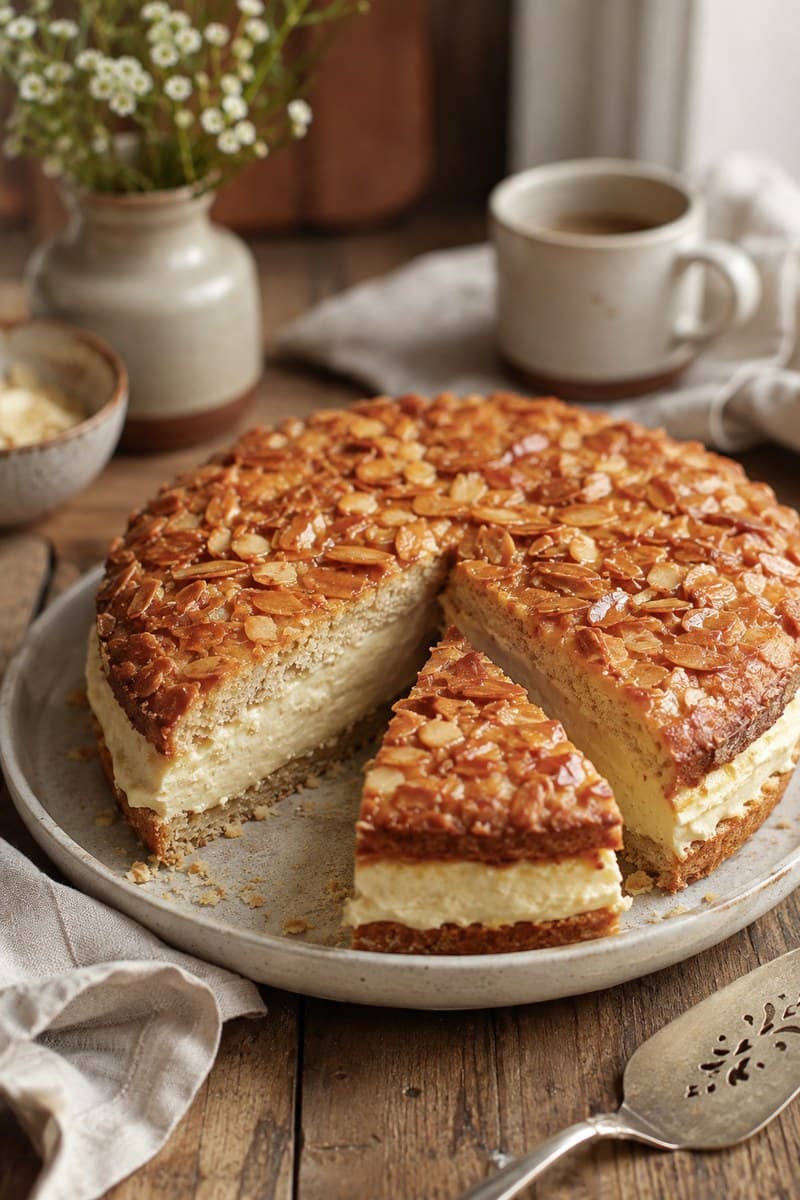
Golden caramelised almonds, soft yeasted cake and a creamy filling have made Bienenstich one of Germany’s best-loved cakes. Known in English as Bee Sting Cake, it is a staple in German bakeries and cafés, yet its unusual name has intrigued bakers for generations.
While the cake itself has well-documented German roots, the story behind its name blends history with folklore. Like many traditional recipes, separating fact from legend is part of its enduring appeal.
What Is Bienenstich?
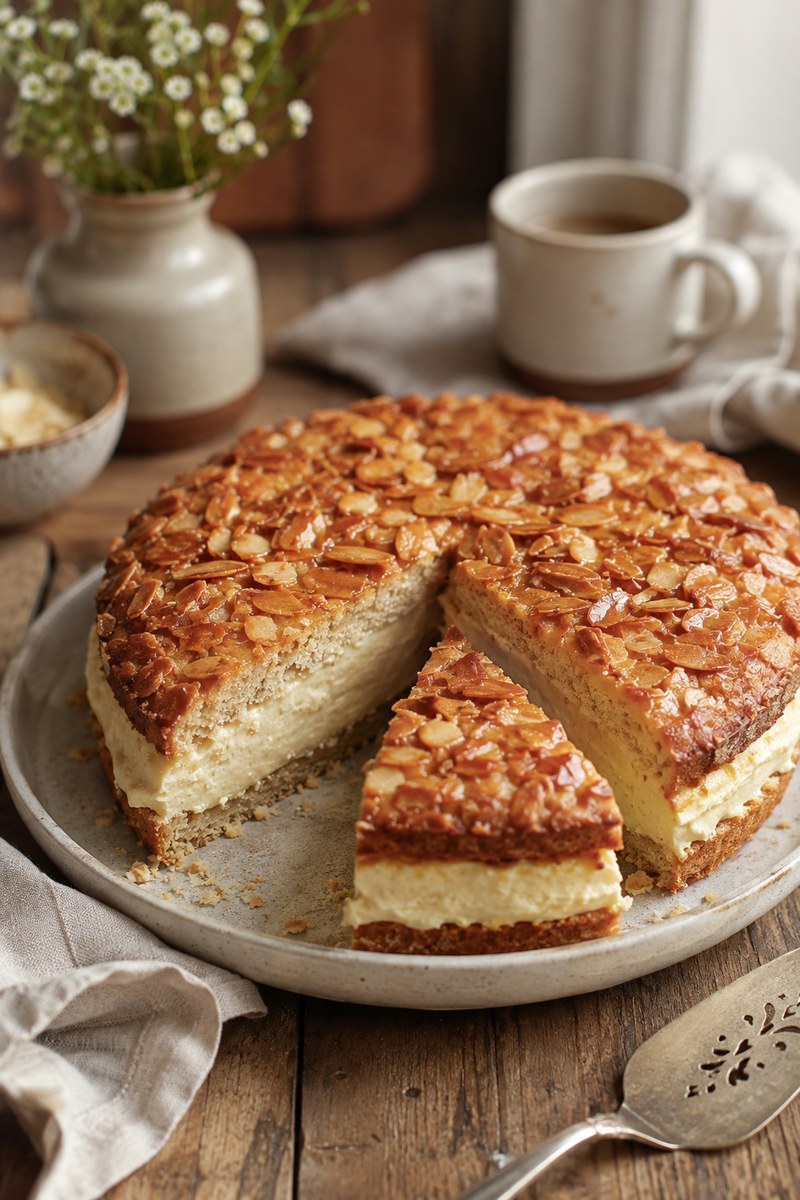
Bienenstich is a traditional German yeasted cake topped with butter, sugar, honey and flaked almonds that caramelise during baking. Once cooled, the cake is sliced horizontally and filled with vanilla pastry cream, whipped cream or a combination of the two.
The contrast between the crisp almond topping, soft bread-like crumb and smooth filling has made it a favourite throughout Germany and beyond.
Although many modern recipes use a sponge cake for convenience, the traditional version is made with enriched yeast dough.
Why Is It Called Bee Sting Cake?
The German word Bienenstich literally means bee sting, but the true origin of the name remains uncertain.
The best-known explanation comes from a medieval legend set in 1474, during a dispute between the neighbouring Rhine towns of Linz am Rhein and Andernach. According to the story, the emperor had transferred the right to collect a valuable Rhine toll from Linz to Andernach. Angered by the loss of this income, the people of Linz planned an attack on their neighbour.
On the morning of the supposed attack, two apprentice bakers from Andernach were walking along the town wall, eating honey from beehives or bee nests hanging nearby. When they spotted the approaching attackers, they threw the hives down at them. The angry bees swarmed around the people of Linz, stinging them and forcing them to retreat.
The townspeople of Andernach are then said to have celebrated their unlikely victory by baking a special cake, later named Bienenstich in honour of the bees that had helped defend the town.
It is a colourful story, but the connection between the legend and the cake appears to have been added much later. An older version of the baker’s apprentice tale contained no reference to Bienenstich, and the story was not clearly linked to the cake until at least 1962. The earliest documented recipes for Bienenstich date only from the beginning of the 20th century, making it highly unlikely that the cake was actually created in 1474.
The name may instead have referred originally to the cake’s hot, sticky topping of caramelised sugar or honey and almonds. Honey may also have encouraged the later association with bees, although there is no definitive evidence for any single explanation.
A Surprisingly Modern Cake
Although the legend is set in the 15th century, documented evidence for Bienenstich appears only in the early 20th century.
The earliest known recipes were published in German and Swiss cookbooks during the early 1900s, leading historians to conclude that the cake itself is a relatively modern creation. One of the earliest references appeared in a 1913 German cookbook, while a German women’s publication in 1914 noted that the cake was “sometimes” filled, suggesting the cream layer had not yet become standard.
Interestingly, in 1925, the German food company Dr. Oetker described Bienenstich in advertisements for its baking books as “not yet generally known”, suggesting that the cake was still a relatively new addition to German baking at the time.
The Cream Filling Became a Signature Feature
Early versions of Bienenstich appear to have been made without a filling. As refrigeration became more common during the 20th century and fresh dairy products became easier to store, bakers increasingly added vanilla pastry cream, buttercream or whipped cream fillings.
Today, the creamy centre is considered one of the cake’s defining characteristics, although bakeries across Germany continue to prepare their own variations.
A Favourite in German Bakeries
Today, Bienenstich is enjoyed throughout Germany, particularly in traditional bakeries and cafés where it is served during the popular afternoon custom of Kaffee und Kuchen.
It is traditionally baked as a rectangular tray cake (Blechkuchen) before being cut into generous squares, making it ideal for family gatherings and celebrations. Round versions are also common.
Beyond Germany, Bienenstich has travelled with German communities and can now be found in bakeries across Austria, Switzerland, North America and Australia.
Interesting Facts About Bienenstich
Despite its name, Bienenstich contains no bees or bee stings. The name refers either to the legendary bee attack or to the honey used in the almond topping.
The caramelised almond topping must be carefully prepared, as the hot sugar mixture can burn quickly if overheated.
Many German bakers recommend serving Bienenstich slightly chilled but allowing it to stand at room temperature for around 20 minutes before eating. This softens the filling slightly and allows the flavours to develop more fully.
A Cake Wrapped in Legend
Whether inspired by brave apprentice bakers defending their town or simply by honey that attracted curious bees, Bienenstich has become one of Germany’s most recognisable cakes.
Its combination of soft yeasted dough, crisp caramelised almonds and creamy filling continues to delight bakers and cake lovers alike. While the famous story behind its name cannot be verified, it has become part of the cake’s identity, ensuring that Bienenstich is remembered not only for its flavour but also for the legend that surrounds it.
Ready to bake your own? Try our Traditional Bienenstich Recipe and enjoy this classic German Bee Sting Cake at home.
References: Davidson, Alan (ed.). The Oxford Companion to Food. Oxford University Press; Goldstein, Darra. The Oxford Companion to Sugar and Sweets. Oxford University Press; Marks, Gil. Encyclopedia of Jewish Food. Wiley; Wikipedia contributors. “Bienenstich.” Wikipedia, The Free Encyclopedia; Wikipedia contributors; “Bienenstich.” Wikipedia, Die freie Enzyklopädie.