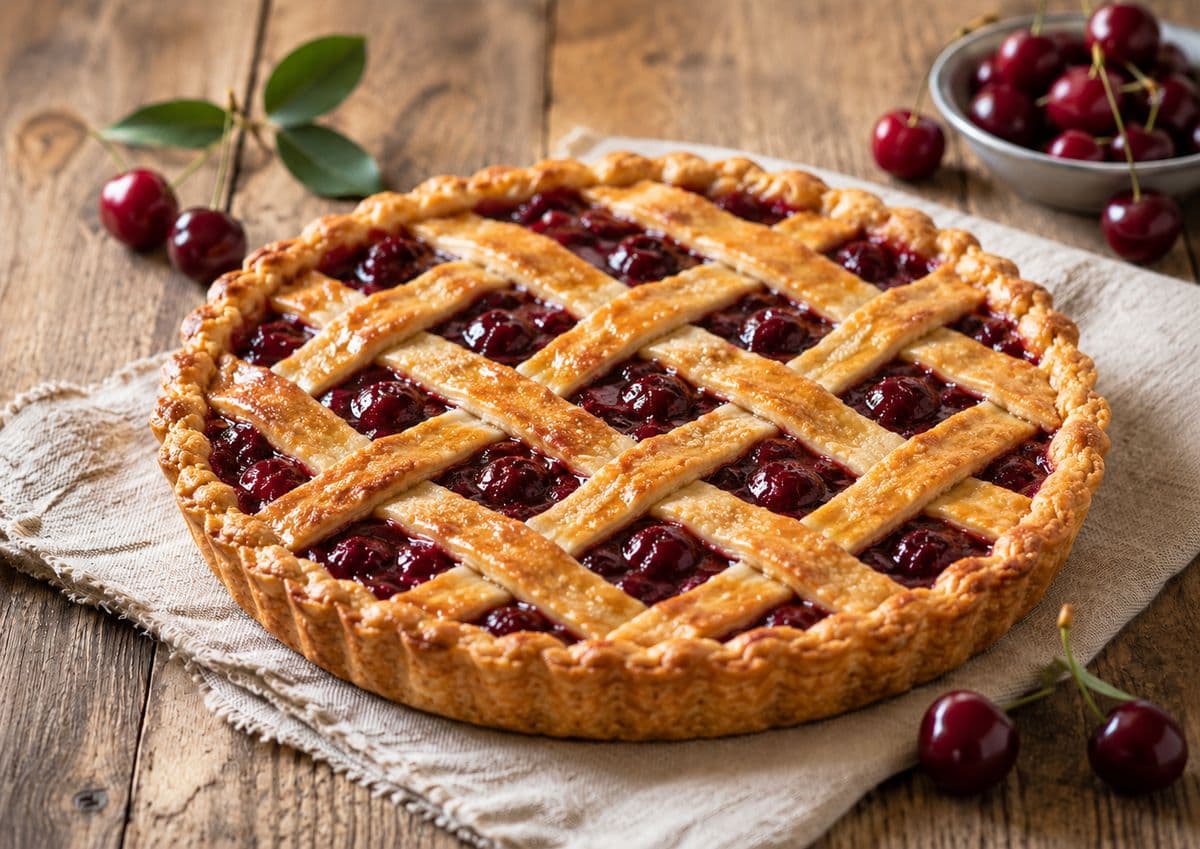
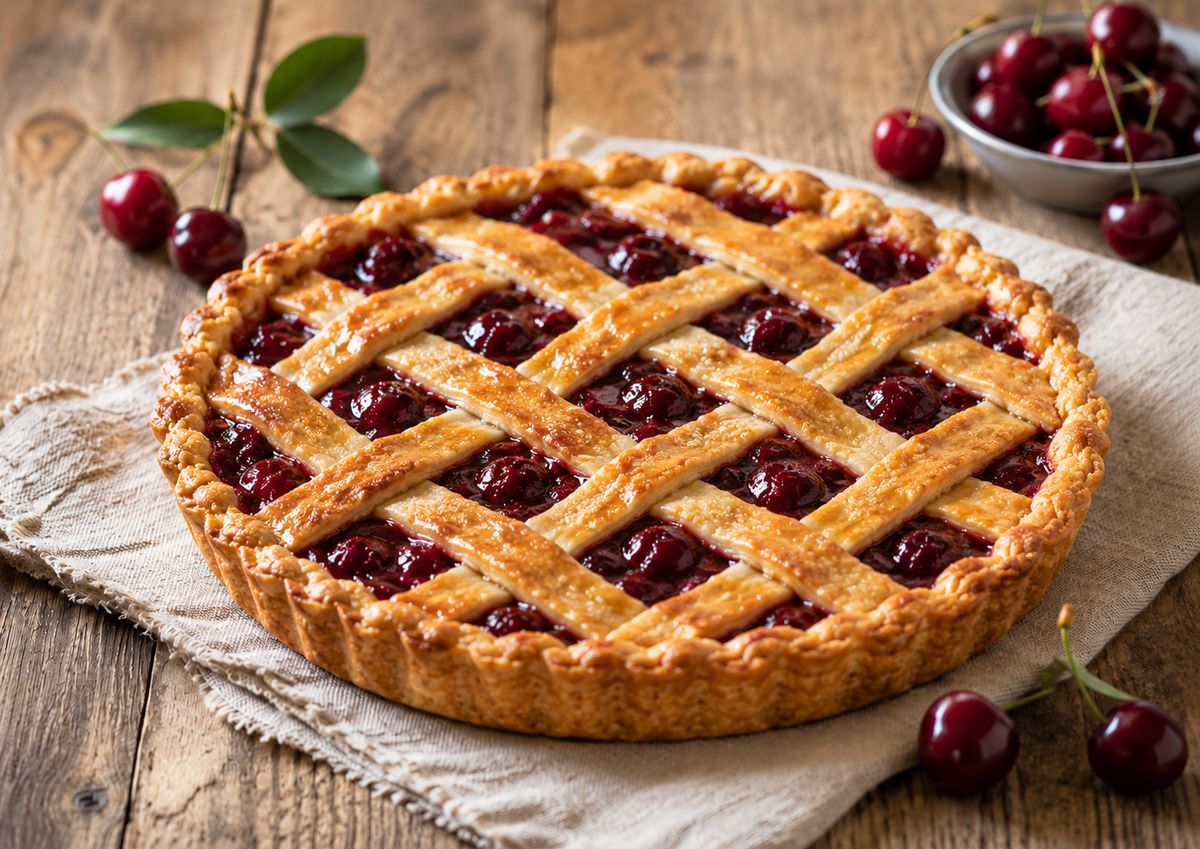
Today is Cherry Tart Day, a curious little food celebration for a dessert that feels far older than the modern calendar that names it.
Cherry tarts are simple at first glance: pastry, cherries, sugar, heat. Yet behind that bright red filling is a long story of fruit, flour, seasonality, status and celebration. The tart has lived many lives. It has appeared as a medieval showpiece, a rustic orchard bake, a refined French-style pastry, a summer picnic dessert and a family recipe handed down through quiet kitchens.
Perhaps that is why cherry tarts still feel so appealing. They are not grand in the way a multi-layered cake is grand. They do not need height, frosting or decoration. Their beauty comes from contrast: crisp pastry against soft fruit, sweetness against sharpness, deep cherry juice against pale golden crust.
A cherry tart looks like summer, but its roots go much deeper.
A food day with a slightly uncertain date
Cherry Tart Day is one of those unofficial food holidays whose exact date is not entirely settled. Some food calendars list it on 18 June, while others place it around 17 June or the third Tuesday of June.
That small uncertainty is oddly fitting. Food traditions rarely begin neatly. They grow from harvests, habits, local recipes, household routines and, much later, modern food calendars. Unlike Christmas pudding or hot cross buns, cherry tarts were not tied to one single religious feast or fixed ritual. They belonged first to the season.
Cherries have always been a fruit of anticipation. Their season is brief. They arrive suddenly, stain fingers quickly and disappear before one has quite had enough of them. A cherry tart is one way of holding on to that moment just a little longer.
Why cherries were made for baking
Cherries are among the most dramatic fruits to bake with because they change so beautifully in the oven. Fresh cherries are firm, bright and juicy, but heat softens them into something deeper and more intense. Their juice thickens, their colour darkens, and their flavour becomes rounder.
For baking, sour cherries have traditionally been especially prized. Sweet cherries are lovely eaten fresh, but sour or tart cherries have the acidity needed to balance sugar and rich pastry. When cooked, that sharpness becomes the thing that makes the dessert interesting. Without it, a cherry tart can taste flat. With it, the filling becomes vivid.
This is why many traditional cherry desserts use Morello, Montmorency, amarelle or other tart cherry varieties. They may be too sharp for casual snacking, but in pastry they come alive. Sugar does not erase their sourness; it frames it.
A good cherry tart is not merely sweet. It should have a little bite.
The tart before the cherry tart
To understand the cherry tart, we need to begin with the tart itself.
Tarts developed from the wider medieval tradition of enclosing or supporting food with pastry. Early pastry was not always the tender, buttery crust we imagine today. In many medieval kitchens, pastry could be thick, sturdy and practical, used to hold fillings during cooking. Some pastry cases were more container than delicacy.
Over time, open-faced tarts became more refined. Instead of hiding the filling beneath a lid, the tart displayed it. This mattered. A pie concealed; a tart revealed.
That made tarts especially suited to wealthy tables. An open tart allowed cooks to show colour, abundance and skill. Custards, fruit, spices and glossy fillings could be arranged in ways that pleased the eye as much as the appetite. In an age when sugar and spices were expensive, a tart could say something about the household that served it.
It was not just food. It was presentation.
Medieval fruit tarts and the taste for sweet-sour flavours
Medieval and early modern European cooking often enjoyed flavours that may surprise modern readers. Sweet and savoury were not always separated as firmly as they are today. Fruit, wine, vinegar, spices, meat, cream and sugar could appear together in ways that now feel unusual.
Early fruit tarts often followed this older taste for balance. A cherry filling might include wine, honey or sugar, cinnamon, ginger, rosewater or a little acidity. The result would not necessarily taste like a modern bakery tart. It may have been more fragrant, spiced and complex.
This is important because the cherry tart did not begin as a plain fruit dessert. It belonged to a world where fruit was often cooked with spices, sweeteners and aromatic ingredients. The cherry brought colour and sharpness; the pastry gave structure; the spices added warmth.
A medieval cherry tart would probably have tasted less like today’s neat pâtisserie slice and more like a sweet-sour, perfumed fruit dish held in pastry.
From courtly tart to household bake
As pastry-making became more familiar and ingredients became more widely available, tarts slowly moved beyond elite kitchens. Better milling, improved ovens, changing sugar access and domestic cookbooks all helped bring fruit tarts into home baking.
By the 17th, 18th and 19th centuries, fruit pies and tarts had become part of many European and American baking traditions. The exact form varied from place to place. Some were open tarts. Some had lattice tops. Some used jam instead of fresh fruit. Some included custard, almonds, cream or cheese.
Cherry was a natural filling because it could be used fresh in season or preserved for later. Cherries could be dried, cooked into preserves, steeped in alcohol, turned into jam or baked into pies and tarts. In colder climates, where fresh fruit was precious, preserved cherries allowed summer flavour to return in winter.
That is one reason cherry desserts often feel nostalgic. They carry the memory of fruit at its peak.
The French influence on the modern fruit tart
When many people imagine a fruit tart today, they picture something with a French accent: crisp pâte sucrée, pastry cream, carefully arranged fruit and a glossy glaze.
This style helped shape the modern image of the tart as an elegant dessert. Instead of simply baking fruit inside pastry, French pâtisserie often separated the elements: a blind-baked shell, a creamy filling and fruit arranged after baking. The result was cleaner, brighter and more decorative.
Cherry tarts can follow this pattern, especially when made with fresh sweet cherries. A pastry shell may be filled with crème pâtissière, almond cream or frangipane, then topped with cherries. In other versions, the cherries are baked directly into the tart so their juices soften and stain the filling.
Both approaches have their charm. The fresh fruit tart celebrates cherries as jewels. The baked cherry tart celebrates them as flavour.
The cherry tart across Europe
One of the lovely things about cherry tarts is that they do not belong to just one country.
In France, cherries appear in fruit tarts, clafoutis and almond-based bakes. In Italy, sour cherry crostata and ricotta-and-cherry tarts are beloved regional desserts. Rome is especially known for ricotta and sour cherry combinations, where creamy cheese meets dark, tangy fruit preserves.
In German-speaking regions, cherry tarts and fruit flans often appear in summer, sometimes with a custard-like filling. In Switzerland and southern Germany, cherry-based bakes can be connected to orchard culture and regional fruit harvests.
In Britain, cherry tarts sit within the larger tradition of fruit pies, jam tarts and afternoon tea baking. In Malta, cherry tart appears in a more specific festive context, with a thin lattice crust associated with celebration.
The form changes, but the idea remains recognisable: cherries and pastry, brought together at the point where fruit is at its most tempting.
Why cherry tarts became linked with summer
The timing of Cherry Tart Day is not accidental. Mid-June falls naturally into cherry season in many parts of the northern hemisphere.
Fresh cherries are a fruit of early summer rather than late summer. Their arrival feels different from apples or pears, which store well and belong to autumn baking. Cherries are more fleeting. They are tender, easily bruised and best used quickly.
That short season helped give cherry desserts their special feeling. A cherry tart was not an everyday bake in the same way as a plain sponge cake or biscuit. It marked a moment. It said: the cherries are here.
This is also why cherry tarts suit picnics, garden tables and midsummer gatherings. They are bright without being heavy, pretty without being fussy, and rich enough to feel like a treat.
A slice of cherry tart belongs to the part of summer that still feels fresh.
The importance of pastry
The filling may get the attention, but pastry decides whether a cherry tart truly works.
Cherry filling is juicy, and that makes it both wonderful and risky. Too much liquid can soften the base, especially if the fruit is baked raw. Traditional solutions include cooking the cherries down slightly, thickening the juices, using breadcrumbs or ground nuts beneath the fruit, or pairing the cherries with almond cream.
Almond is one of cherry’s best partners. The two share a natural affinity, which is why cherry and almond appear together in so many desserts. A layer of frangipane beneath cherries gives structure, absorbs juice and adds richness. It also makes the tart feel more substantial.
A plain pastry shell gives sharpness and simplicity. An almond filling gives softness and depth. A lattice top gives rustic charm. A glossy open tart gives elegance.
There is no single correct cherry tart. That is part of its survival.
Cherry tart, cherry pie and cherry clafoutis
Cherry tart often overlaps with other cherry desserts, but each has its own personality.
A cherry pie is usually deeper, juicier and more generous, often with a top crust or lattice. It is the cosy, abundant cousin.
A cherry tart is shallower and more pastry-focused. It is neater, sometimes more refined, and often designed to show off the fruit.
A clafoutis is different again. It is a French baked dessert in which cherries are set in a batter somewhere between custard and pancake. It has no pastry shell at all, yet it shares the same seasonal instinct: take ripe cherries and bake them simply.
All three desserts tell the same truth. Cherries do not need much.
Why cherry tarts still appeal today
Modern baking often chases novelty: new flavours, new shapes, new decorations, new trends. The cherry tart quietly resists that. It does not need to be reinvented to remain appealing.
Its strength is that it gives us what many people want from baking now: seasonality, simplicity and a sense of connection to older kitchen rhythms. It reminds us that not every dessert has to be elaborate to feel special.
A cherry tart can be made rustic or refined. It can be served warm with cream, cool with coffee, or plain from the fridge the next day. It can be made with fresh cherries in season or sour cherry preserves when fresh fruit is unavailable. It can be French, Italian, British, German, Maltese or simply homemade.
That flexibility is why it has lasted.
A small celebration of a short season
Cherry Tart Day may be a modern food-calendar invention, but the dessert it celebrates has real history behind it. Tarts have been part of European baking for centuries. Cherries have long been prized for their vivid colour and sharp-sweet flavour. Together, they make a dessert that feels both old and fresh.
There is something quietly beautiful about that.
A cherry tart does not try to impress with height or excess. It offers a crisp edge, a tender centre and the taste of fruit at its brief best. It is the kind of bake that makes sense of a season.
And perhaps that is the real reason to celebrate it.
Not because a calendar tells us to, but because cherries do not wait.
Cherry tarts are only one part of a much wider tart tradition. You can read more about classic pastry bakes in our articles on Tarte Bourdaloue, Tarte au Citron and other heritage desserts.
REFERENCES: National Cherry Growers & Industries Foundation, “Cherry History”; National Day Calendar, “National Cherry Tart Day”; Food Timeline, “Pies & Pastry”; Britannica, “Cherry”; King Arthur Baking, “Cherry Pie”.