Today is National Chocolate Eclair Day, which feels like a rather elegant excuse to talk about one of the most recognisable pastries in the world.
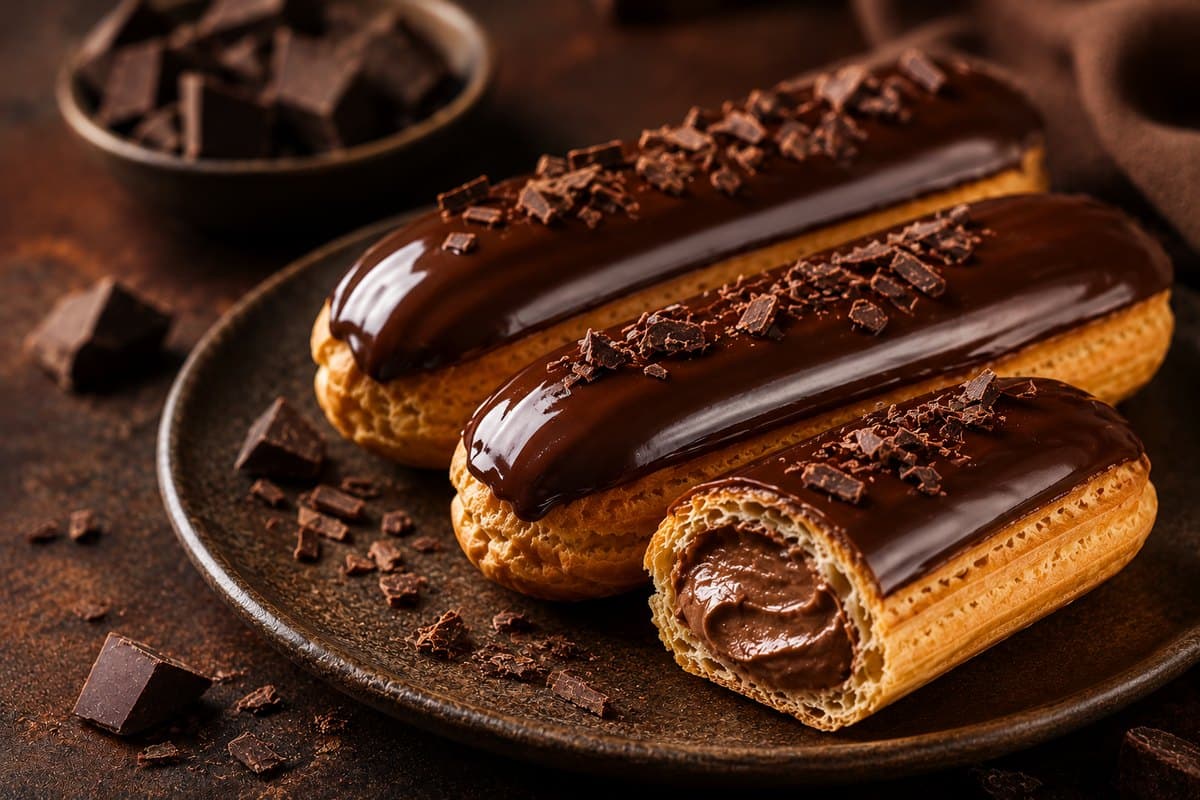
A chocolate éclair looks simple at first glance: a long shell of choux pastry, a soft cream filling, and a glossy chocolate top. Yet behind that neat little pastry is a story of French technique, royal kitchens, pastry shop refinement, and the quiet brilliance of a dough that rises not with yeast, but with steam.
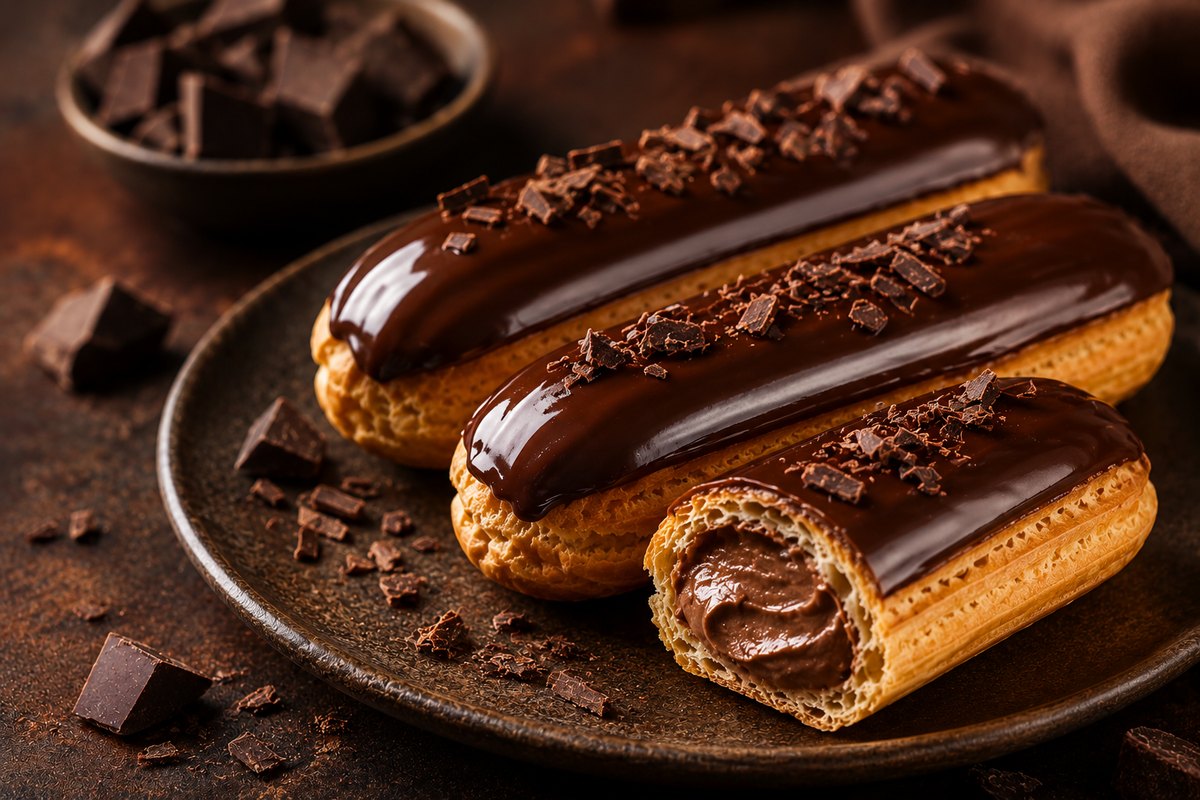
The éclair is not a rustic bake. It belongs to the polished world of pâtisserie, where small details matter: the thickness of the choux paste, the spacing of the piped lines, the dryness of the baked shell, the smoothness of the filling, and the shine of the glaze. It is a pastry that rewards precision, but also one that has remained wonderfully familiar. Even today, the classic chocolate éclair still has the same appeal: crisp, creamy, dark, sweet, and gone far too quickly.
What Is a Chocolate Éclair?
A chocolate éclair is a long French pastry made from pâte à choux, the same pastry used for profiteroles, cream puffs, Paris-Brest, and gougères. Choux pastry is unusual because it is cooked twice. First, water or milk, butter, flour, and sometimes sugar are cooked together on the stove to form a paste. Eggs are then beaten in to create a soft, pipeable dough. When baked, the moisture inside the dough turns to steam, causing the pastry to puff and form a hollow centre.
That hollow centre is what makes the éclair so perfect for filling. Traditionally, éclairs are filled with pastry cream, cream, or custard, then topped with fondant icing or a chocolate glaze. The chocolate version became one of the most enduring styles because it balances the lightness of choux pastry with the richness of cocoa.
A good chocolate éclair is all about contrast. The shell should be light but not soggy. The filling should be smooth but not runny. The chocolate top should be dark enough to give depth, yet soft enough to bite through without pulling the whole pastry apart. It is elegant, but not fussy. That may be why it has lasted so long.
The French Origins of the Éclair
The éclair is usually traced to 19th-century France, where it developed from earlier choux pastry traditions. Before it became known as an éclair, the pastry was reportedly called pain à la Duchesse or petite duchesse. These names suggest something refined and aristocratic, which suits the pastry’s neat shape and delicate filling.
Many food histories connect the éclair to Marie-Antoine Carême, one of the great names of French cuisine. Carême worked in the late 18th and early 19th centuries and became famous for his elaborate pastry work, architectural desserts, and service to aristocratic and royal households. While it is difficult to prove that he personally invented the éclair as we know it today, he was deeply associated with the development of refined French pastry, and the éclair belongs very naturally to that world.
By the middle of the 19th century, the pastry had taken on the name éclair. In French, éclair means “flash of lightning”. There are several explanations for the name. Some say it refers to the way the pastry is eaten quickly, in a flash. Others suggest it may refer to the shine of its glaze, especially when topped with a glossy chocolate or fondant coating. Both ideas feel plausible, and both add to the pastry’s charm.
Why Choux Pastry Made the Éclair Possible
The éclair could not exist without choux pastry. Unlike shortcrust pastry, puff pastry, or enriched bread dough, choux pastry depends on steam for its lift. There is no yeast, and usually no chemical raising agent. Instead, the dough’s high moisture content creates steam in the oven, pushing the pastry outward and leaving a hollow centre.
This makes choux pastry both magical and demanding. If the dough is too wet, it may collapse. If it is too dry, it may not expand enough. If the shells are underbaked, they can soften after cooling. This is why éclairs are often seen as a test of technique. They are not difficult because they contain rare ingredients; they are difficult because they ask the baker to understand timing, texture, and heat.
For professional pâtissiers, that technical nature became part of the éclair’s appeal. A plain choux shell could become a canvas for pastry cream, coffee cream, chocolate custard, fruit fillings, praline, caramel, or modern flavoured creams. Yet the chocolate éclair remained the classic: familiar, balanced, and instantly recognisable.
The Chocolate Éclair Becomes a Classic
Chocolate was already changing European baking by the time the éclair became established. For centuries, chocolate had been consumed mainly as a drink. In the 19th century, improvements in cocoa processing helped make chocolate easier to use in confectionery and baking. As chocolate became smoother, more available, and more adaptable, it found its way into cakes, creams, glazes, and pastry fillings.
The chocolate éclair was a natural match. Choux pastry itself is relatively plain, which allows richer fillings and toppings to shine. A chocolate glaze gives the pastry visual drama, while a custard or cream filling gives it softness. Together, they create a dessert that feels luxurious without being heavy.
The classic chocolate éclair also suited the pastry shop display case. Its long, neat shape made it easy to arrange in rows. Its shiny top caught the eye. Its individual portion size made it convenient to buy and eat. In that sense, the éclair was both refined and practical: a small luxury for the everyday customer.
From French Pâtisseries to the Wider World
By the late 19th century, éclairs had begun appearing in English-language cookbooks, including American cookery texts. As French pastry techniques travelled, the éclair became known beyond France and entered bakery culture in many countries.
In some places, the word “éclair” remained closely tied to the French choux pastry original. In others, it became more loosely applied to long cream-filled pastries, including doughnut-like versions. This can sometimes cause confusion. A true éclair is made from choux pastry, not fried dough. Its lightness comes from steam, not yeast.
Over time, the éclair became a familiar bakery item in Europe, North America, and beyond. It was elegant enough for a pastry shop, but approachable enough for home bakers who wanted to try French baking. Its ingredients were not especially extravagant: butter, flour, eggs, milk, sugar, chocolate. What made it special was the method.
The Modern Éclair
In recent years, éclairs have been revived by modern pastry chefs as a stylish, highly adaptable dessert. Classic chocolate and coffee versions still remain popular, but contemporary pâtisseries now offer éclairs filled with pistachio cream, salted caramel, lemon curd, raspberry, matcha, hazelnut, praline, or even savoury fillings.
The decoration has changed too. Instead of a simple chocolate fondant top, modern éclairs may have mirror glazes, piped cream, chocolate plaques, nuts, fruit, edible flowers, or crisp textured toppings. In some pâtisseries, the éclair has become almost as decorative as a small cake.
Yet the old-fashioned chocolate éclair still has a special place. It does not need bright colours or complicated decoration. Its appeal lies in the simple pleasure of choux pastry, cream, and chocolate. It is a pastry built on restraint, and that restraint is exactly what makes it timeless.
Why Chocolate Éclairs Still Feel Special
Part of the éclair’s charm is that it feels both familiar and impressive. It is not as large as a cake, not as crumbly as a tart, and not as rich as a full plated dessert. It is neat, elegant, and self-contained. You can eat it with a fork in a café or, less gracefully but very happily, by hand.
It also carries the romance of French pâtisserie without being too distant from home baking. Many home bakers eventually try choux pastry because it feels like a milestone. The first successful tray of puffed éclairs is deeply satisfying. The shells rise, the centres hollow out, the filling goes in, the chocolate glaze sets, and suddenly something that once looked like a bakery-only pastry becomes possible in a home kitchen.
That is perhaps why the chocolate éclair has endured. It is technical, but not unreachable. Elegant, but not cold. Classic, but still open to reinvention. And on National Chocolate Eclair Day, it deserves a little more attention than simply being eaten in a flash.
A Pastry Worth Remembering
The chocolate éclair may be small, but it carries a long history of French pastry craft. From its 19th-century origins to its modern pastry shop revivals, it has remained one of the most beloved examples of what choux pastry can become.
At its best, a chocolate éclair is a lesson in balance: crisp shell, smooth filling, glossy chocolate, and just enough sweetness. It reminds us that some bakes survive not because they are complicated, but because every part has a purpose.
Perhaps that is the real magic of the chocolate éclair. It disappears quickly, as its name suggests, but its place in pastry history has lasted for generations.
References: National Day Calendar, “National Chocolate Eclair Day”; Larousse Gastronomique; The Spruce Eats, “Éclair History and Characteristics”; Mrs. D. A. Lincoln, Boston Cooking School Cook Book; Food Nouveau, “How to Make Chocolate Éclairs”; The Oxford Companion to Sugar and Sweets.