
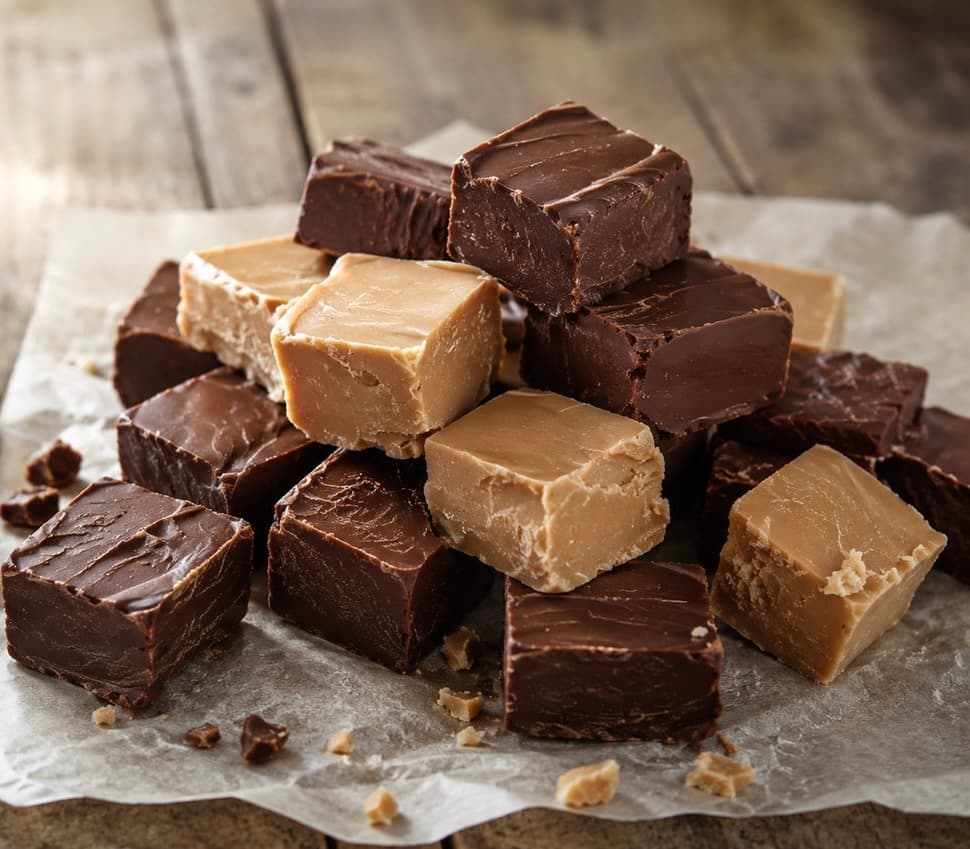
Fudge has the charm of an old-fashioned sweet shop: neat squares stacked behind glass, a rich milky scent in the air, and that dense, creamy bite that sits somewhere between caramel, fondant, and candy. Every year on 16 June, it even has its own food holiday: National Fudge Day.
What Is Fudge?
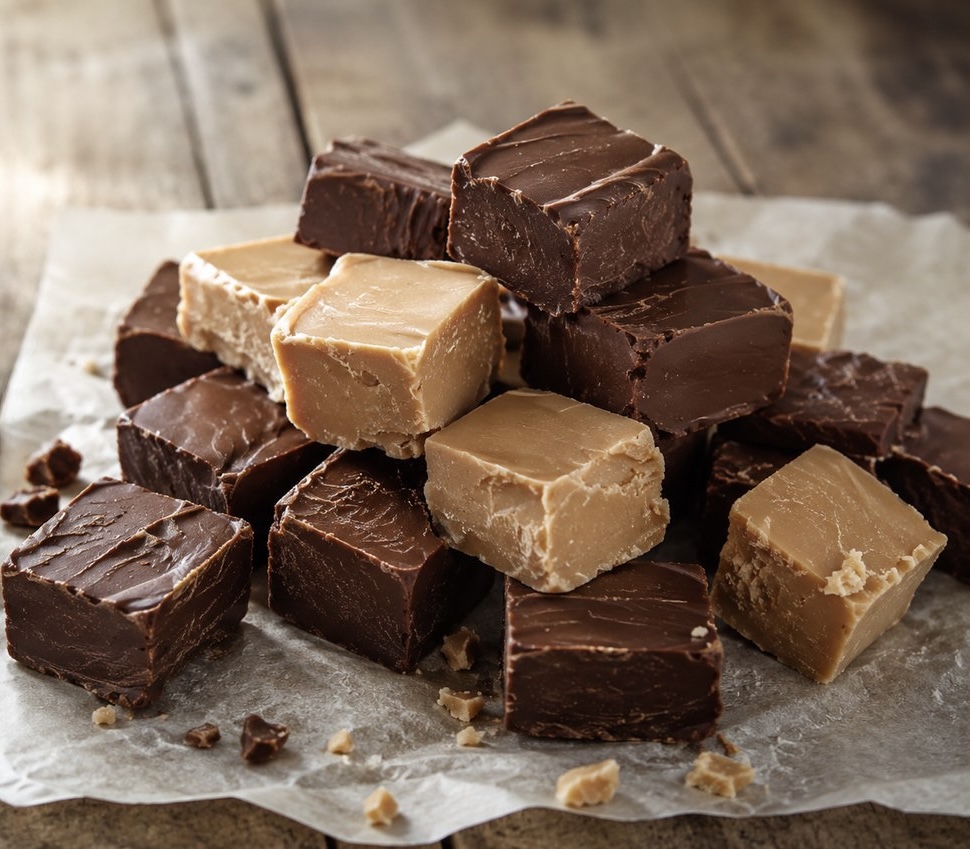
Fudge is a soft crystalline confection usually made by cooking sugar, butter, and milk or cream, often with chocolate, until the mixture reaches the right temperature and concentration. When cooled and beaten properly, the sugar forms many tiny crystals. These crystals are small enough to feel smooth rather than gritty, giving fudge its characteristic creamy texture.
That texture is what separates proper fudge from ordinary candy. It should not be hard like brittle, chewy like caramel, or silky like ganache. A good piece of fudge has a slight firmness when cut, then softens richly in the mouth. It is sweet, dense, and satisfying in small pieces — although, in real life, few people stop at one.
The American Origins of Fudge
The most commonly repeated story places the origins of fudge in the United States during the 1880s. One of the earliest known written references comes from Emelyn Battersby Hartridge, a student at Vassar College.
Hartridge later wrote that a schoolmate’s cousin had made fudge in Baltimore in 1886 and sold it for 40 cents a pound. In 1888, Hartridge reportedly made a large batch for a senior auction at Vassar.
This does not prove that Hartridge invented fudge herself. In fact, the more careful version of the story suggests that she helped document and popularise a sweet that was already circulating in recipe form.
The name, too, hints at informality. “Fudge” was already used as a word meaning something botched, improvised, or adjusted. Food historians often link the sweet’s name to the idea of a “fudged” batch of caramel or candy, although the exact naming story is not fully proven.
That uncertainty is part of fudge’s charm. It was not born in a royal kitchen or attached to a grand culinary school. It seems to have moved through letters, dorm rooms, family recipes, and informal exchanges — the kind of sweet people made, shared, copied, and adapted.
Fudge and Women’s College Culture
By the late 19th and early 20th centuries, fudge had become strongly associated with American women’s colleges. At institutions such as Vassar, Wellesley, and Smith, students made fudge in their rooms, often using simple equipment and ingredients they could manage outside a formal kitchen.
This gave fudge a social life of its own. It was not merely a sweet; it was a dorm-room ritual. Students gathered around hot sugar mixtures, stirred pans, shared batches, and exchanged recipes. In an environment where young women were increasingly pursuing higher education, fudge became part of a small domestic ritual that was cosy, communal, and slightly mischievous.
The sweet spread quickly because it was practical. It did not require professional confectionery equipment, and its ingredients were familiar. Sugar, milk, butter, and chocolate were easier for home cooks to work with than more elaborate candies. Once a reliable method was known, fudge could be made in batches, cut into squares, wrapped, sold, gifted, or carried to gatherings.
Why Chocolate Became Central to Fudge
Although fudge can be made in many flavours, chocolate became the classic version. This was partly because chocolate itself was changing during the 19th century. Earlier European chocolate had been consumed mainly as a drink, but improvements in cocoa processing helped turn chocolate into a more versatile baking and confectionery ingredient.
By the time fudge began appearing in American recipes, chocolate was no longer just a luxury drink. It was becoming an ingredient that home cooks could add to cakes, candies, puddings, and sauces. Chocolate gave fudge depth and colour, balancing its intense sweetness with bitterness and richness.
The result was a sweet that felt indulgent but approachable. It had the sophistication of chocolate, but the homeliness of a kitchen-made candy.
The Science Behind Creamy Fudge
Fudge may look simple, but it is surprisingly technical. The main challenge is sugar crystallisation. When sugar, milk, and butter are boiled together, water evaporates and the sugar becomes concentrated. If the mixture is handled correctly, it forms a mass filled with very small sugar crystals. Those tiny crystals create the smooth, creamy texture people associate with good fudge.
If the crystals grow too large, the fudge becomes grainy. If the mixture is not cooked enough, it may remain too soft. If it is overcooked, it can become dry, hard, or crumbly.
This is why older fudge recipes often feel precise and slightly intimidating. They depend not only on ingredients, but also on temperature, timing, cooling, and beating.
Traditional fudge is usually cooked to the soft-ball stage, then left to cool before being beaten. That waiting period matters. Stirring too early can encourage large crystals; beating at the right moment helps create a finer texture.
Modern shortcut fudge often avoids this delicate process by using condensed milk, chocolate chips, marshmallow crème, or other stabilising ingredients. These versions are easier and very popular, but they are slightly different from old-fashioned fudge, which relies more heavily on cooked sugar technique.
From Homemade Sweet to Tourist-Shop Classic
As fudge became more popular, it moved beyond college dormitories and home kitchens. In the 20th century, it became a staple of sweet shops, seaside towns, holiday destinations, and tourist areas. Fudge was easy to display, easy to cut, and easy to sell by weight. It could also be adapted endlessly.
Chocolate remained the classic, but vanilla, maple, peanut butter, walnut, rocky road, rum raisin, mint chocolate, and salted caramel versions followed.
In Britain and other Commonwealth countries, fudge became especially popular as a gift sweet, often sold in tins, boxes, or paper bags from traditional confectioners.
Part of fudge’s appeal is its sense of abundance. A tray of fudge looks generous. It can be sliced into large squares, tiny cubes, or uneven homemade pieces. It suits Christmas markets, school fairs, bake sales, and handmade gifts. Few sweets manage to feel both humble and luxurious at the same time.
Fudge Around the World
Although fudge is most strongly associated with the United States, it has travelled widely. In Britain, fudge is often linked with traditional sweet shops and holiday towns.
In parts of Scotland, tablet is sometimes compared with fudge, although the two are not the same. Scottish tablet is usually grainier, more brittle, and more intensely sugary, while fudge is softer and creamier.
In the United States, regional fudge shops became part of the experience of visiting certain tourist destinations. Mackinac Island in Michigan, for example, became especially famous for fudge, with shops making it in front of visitors on marble slabs. Watching fudge being poured, cooled, worked, and cut became part of the attraction.
This public performance helped keep fudge alive as a nostalgic sweet. It was not just something to eat; it was something to watch being made.
Why Fudge Still Feels Nostalgic
Fudge has survived because it carries memory so well. It belongs to gift boxes, school fairs, family kitchens, Christmas tables, and sweet-shop counters. It is not refined in the delicate sense, but it is rich with feeling.
There is also something wonderfully honest about fudge. It does not pretend to be light. It is sweet, dense, buttery, and unapologetically indulgent. In a world of airy desserts and carefully plated sweets, fudge remains satisfyingly solid.
Its history also reminds us how many beloved foods are not created in one perfect moment. They move through kitchens slowly. Someone makes a batch. Someone writes down the method. Someone changes the flavour. Someone sells it at a fair. Someone carries it home wrapped in paper. Over time, a simple sweet becomes tradition.
A Sweet Worth Remembering
The history of fudge is a story of American home confectionery, women’s college culture, chocolate’s rise as a kitchen ingredient, and the delicate science of sugar crystals. Its origins may be partly uncertain, and National Fudge Day may be a modern addition to the food calendar, but the sweet itself has earned its place in baking and confectionery history.
Fudge endures because it is generous, adaptable, and deeply nostalgic. Whether made the old-fashioned way with careful boiling and beating, or in a modern shortcut version with condensed milk and melted chocolate, it remains one of the simplest ways to turn sugar and cocoa into comfort.
REFERENCES
Vassar College Chronology. “November 12, 1893.”
Vassar Miscellany News. “Vassar Unexpectedly Integral to Fudge’s Life Story.”
Exploratorium. “Science of Candy: What’s Special About Fudge?”
National Day Calendar. “National Fudge Day — June 16.”
Holiday Insights. “National Fudge Day.”