Around the World in 80 Bakes: Stop #64 — Kladdkaka
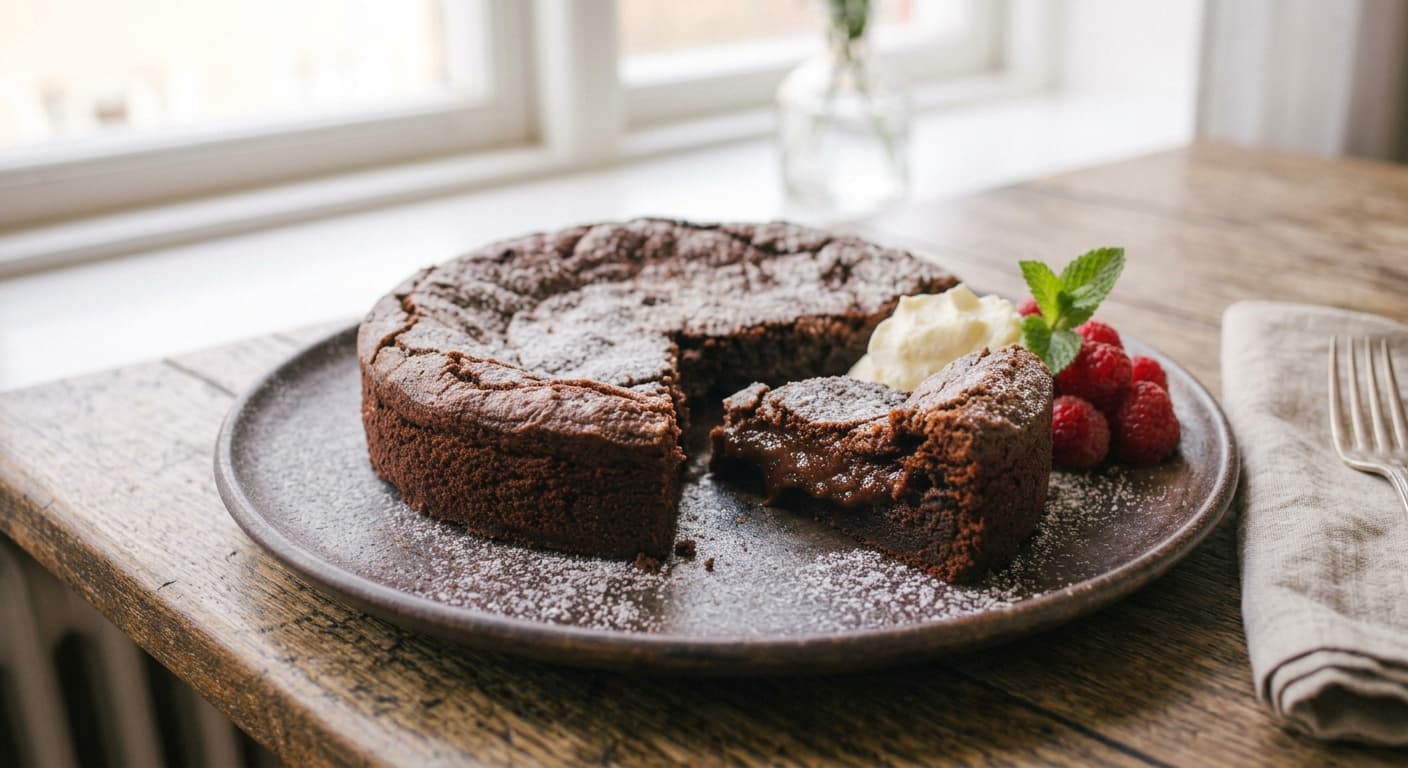
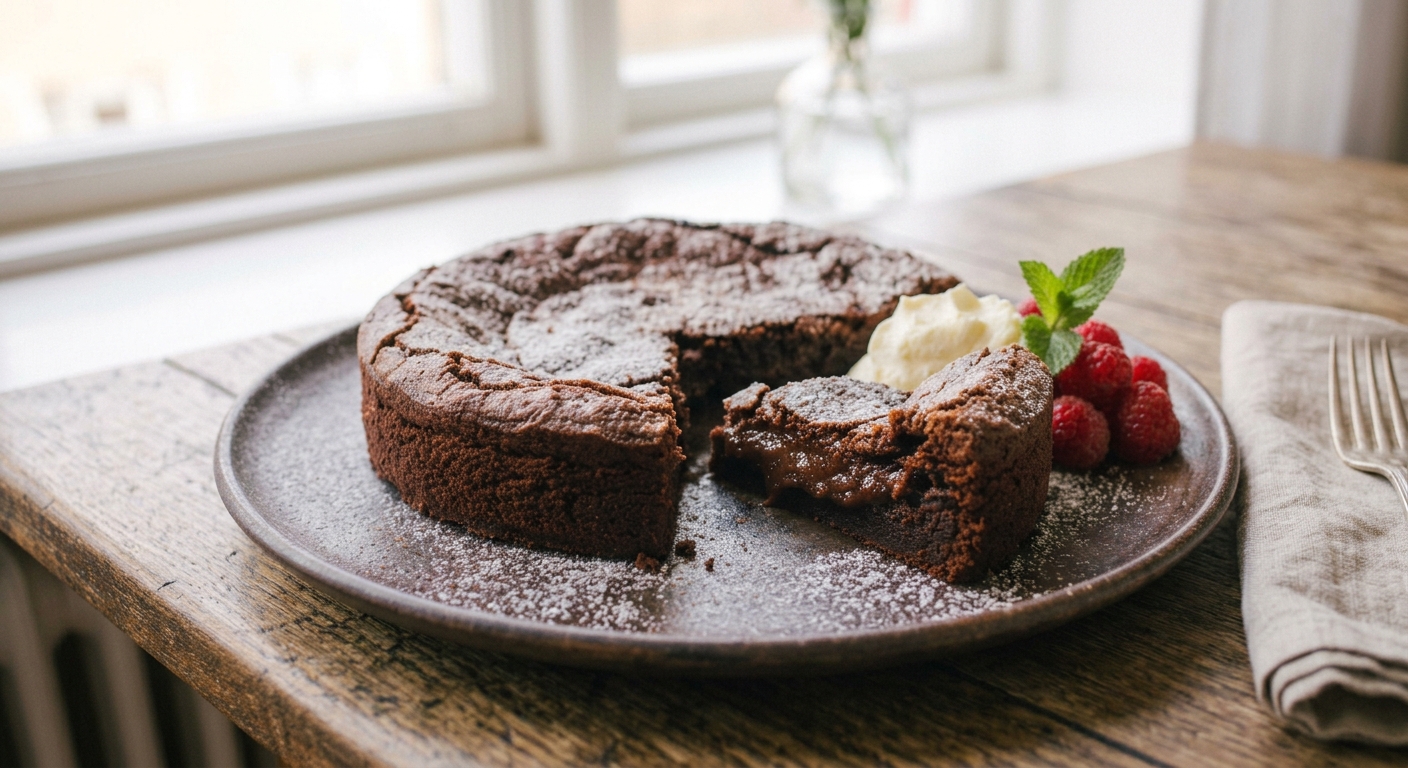
Kladdkaka breaks one of the familiar rules of cake baking. Instead of rising into a light, airy crumb, it is deliberately kept dense and sticky in the centre. Its thin top may crack as it cools, while the middle remains soft enough to cling to a fork. In Sweden, these are not signs of failure. They are precisely what make the cake so well loved.
Today, kladdkaka is a familiar sight in Swedish homes and cafés, yet it appears to be a relatively modern creation. Its exact beginnings remain uncertain, but the most credible story leads from a chocolate cake eaten in Paris to a recipe published in a Swedish magazine during the late 20th century.
What Is Kladdkaka?
The name describes the cake plainly. In Swedish, kladdig means sticky, gooey or messy, while kaka means cake. Kladdkaka can therefore be translated as “sticky cake”, although its Swedish name is usually retained in English.
A classic kladdkaka is generally made with butter, sugar, eggs, flour and cocoa. It contains little flour and usually no baking powder. The batter is mixed without incorporating much air and baked only until the edges are set and the centre remains soft.
The absence of a raising agent helps prevent an airy crumb, but it is not the only reason for the cake’s texture. The proportions of butter, sugar and flour, minimal aeration and short baking time all contribute to its dense, sticky centre and thin, slightly crisp surface.
Kladdkaka is usually baked as a single round cake and served in wedges, often with lightly whipped cream, vanilla ice cream or tart berries. It is simple in appearance, with no need for layers, filling or elaborate decoration.
An Origin That Remains Uncertain
One story places the beginnings of kladdkaka in Sweden during the Second World War. According to this account, an American brownie recipe was adapted without baking powder because the ingredient was difficult to obtain. However, versions of the story differ and reliable contemporary evidence supporting it is scarce.
Kladdkaka and brownies clearly belong to the same broad family of dense chocolate bakes, but similarity does not prove a direct connection. Many brownie recipes are also made without a raising agent. The wartime account is therefore best treated as one of the legends surrounding kladdkaka rather than as established history.
A better-supported explanation connects the cake’s development with Swedish food writer Margareta Wickman and the magazine Vecko-Journalen.
Margareta Wickman and the Paris Connection
According to the most widely accepted account, Wickman ate an unusually soft chocolate cake at a restaurant near a flea market in Paris. The visit is commonly dated to 1968. She obtained the recipe and brought the idea back to Sweden.
During the late 1970s, Vecko-Journalen published a recipe for kladdiga chokladmuffins, or sticky chocolate muffins, associated with Wickman’s discovery. The recipe bore strong similarities to the kladdkaka known today and is thought to have helped introduce this style of chocolate baking to a wider Swedish audience.
This does not establish Wickman as the sole inventor of kladdkaka. Soft chocolate cakes already existed elsewhere, and recipes often evolve as they move between countries, publications and home kitchens. Her magazine recipe is better understood as an important step in popularising the cake in Sweden.
From Magazine Recipe to Swedish Favourite
Kladdkaka became particularly popular during the 1990s, alongside the expansion of Swedish café culture. It fitted naturally into fika, the Swedish custom of pausing for coffee and something sweet with family, friends or colleagues.
The cake offered the richness of a chocolate dessert without requiring specialist equipment or advanced decorating skills. Its ingredients were inexpensive and commonly kept at home, while the batter could be stirred together quickly. It was equally practical for home kitchens and café counters: easy to prepare, slice and serve with a spoonful of cream.
Its forgiving, informal character also made it an approachable bake for beginners. The quality that might cause concern in another cake—a soft centre—was the intended result. The principal challenge was simply knowing when to remove it from the oven, as a few extra minutes could change it from sticky to dry.
Is Kladdkaka the Same as a Brownie?
Kladdkaka is often compared with the American brownie, but the two are not interchangeable. Both are rich chocolate bakes and both can have dense, fudgy centres. Brownies, however, are normally baked in a square or rectangular tin and cut into individual pieces. Their texture may be cakey, chewy or fudgy, depending on the recipe.
Kladdkaka is traditionally baked as one round cake and served in wedges. Its sticky centre is not simply one possible variation but its defining feature.
It is also different from a molten chocolate cake. Molten cakes are generally baked in individual portions and served warm with flowing centres. Kladdkaka is a full-sized cake with a soft, dense interior rather than a liquid chocolate centre. It may be served warm, at room temperature or chilled, when its texture becomes firmer and fudgier.
A Cake with Its Own Celebration
Sweden celebrates Kladdkakans dag, or Kladdkaka Day, on 7 November. The originator of the occasion is unclear, but its annual appearance on the Swedish food calendar shows how firmly the cake has become associated with the country’s baking culture.
Modern bakers have also extended the idea beyond the classic cocoa version. Variations may include coffee, liquorice, lemon or white chocolate. Saffranskladdkaka, made with saffron, is particularly associated with the Christmas season. These versions retain the low, dense form and deliberately sticky centre that define the original.
From Imperfection to Swedish Classic
Kladdkaka does not have the centuries-old history of many European cakes. Its development appears to belong largely to the second half of the 20th century, influenced by chocolate bakes from beyond Sweden and carried into Swedish homes through magazines, cafés and everyday recipe sharing.
Perhaps that relatively recent and uncertain history suits the cake. Kladdkaka is not defined by ceremony or precise decoration. It welcomes a cracked top, uneven slices and a centre that clings to the knife. What might be considered unfinished in another cake became the whole point — and helped create a modern Swedish favourite.
Bake this at home with our Easy Swedish Chocolate Cake (Kladdkaka Recipe), featuring a delicate crust and rich, sticky centre.
References
ICA. “Kladdkakans historia.”
Baka.se. “Bakverk med historia.”
Arla. “Kladdkakans dag.”
Svenska Akademiens ordböcker. “Kladdkaka.”
Sveriges Radio. “Kladdkakan.” 29 August 2012.
SVT Nyheter. “Kladdkakan firas idag – krockar med Gustav Adolfsbakelsen.” 6 November 2015.