Around the World in 80 Bakes: Stop #67 — Dobos Torte
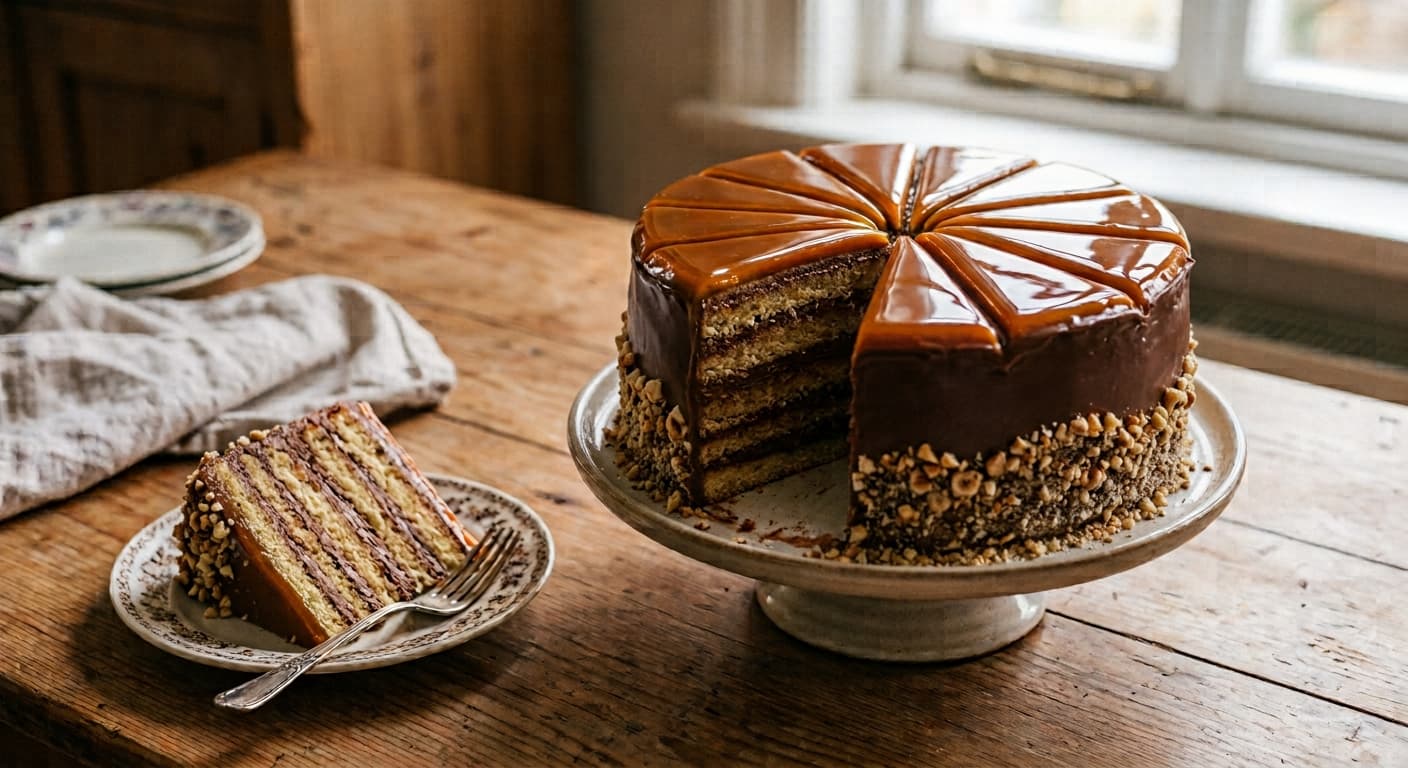
With its thin layers of sponge, rich chocolate buttercream and gleaming caramel top, Dobos torte is one of Hungary’s most recognisable cakes. Its elegant appearance was strikingly modern when it first appeared in the late 19th century, but its construction served a practical purpose too. The cake kept better than many cream-filled desserts at a time when reliable refrigeration was not widely available.
Created by Hungarian chef and delicatessen merchant József C. Dobos, the cake made its public debut in Budapest in 1885. It soon became fashionable beyond Hungary, carrying its creator’s name across Europe.
Who Was József C. Dobos?
József C. Dobos was born in Pest in 1847 into a family of cooks. He became a respected chef, food merchant and culinary writer during a period of considerable change in Budapest.
By 1876, Dobos had opened a speciality food shop in central Pest. It sold high-quality Hungarian produce alongside imported cheeses, wines, caviar and spices. The shop was also known for foods prepared by Dobos himself.
A well-known Hungarian–French Cookbook was published under his name in 1881, although Hungarian food historians have raised questions about its authorship and the origins of some of its recipes.
Budapest was developing into a prosperous European capital during Dobos’s career. Its coffee houses, restaurants and elegant food shops offered the ideal setting for an ambitious new cake.
The Creation of Dobos Torte
Dobos developed his famous torte during the 1880s. Many elaborate cakes of the period contained whipped cream or cooked custard, which spoiled relatively quickly. Dobos instead combined thin sponge layers with a rich chocolate buttercream and finished the cake with a hard caramel-covered sponge.
The buttercream was more stable than many commonly used cream fillings, giving the torte a longer shelf life. This made it better suited to storage and transportation without sacrificing the richness expected of a luxury dessert.
The cake’s appearance was equally distinctive. Rather than covering it with elaborate piping and ornamentation, Dobos created a comparatively low, neat cake with clearly defined layers and a smooth amber top. Its restrained design looked unusually modern beside the heavily decorated celebration cakes fashionable at the time.
A Sensation at the 1885 Budapest Exhibition
Dobos presented his torte at the National General Exhibition in Budapest in 1885. He operated an elaborate pavilion at the event, where Emperor Franz Joseph I and Empress Elisabeth were among those who tasted the new cake.
The exhibition introduced Dobos torte to a large and influential audience. Its combination of chocolate, buttercream, delicate sponge and crisp caramel soon attracted attention beyond Budapest.
Dobos promoted the cake during his travels and shipped it to customers elsewhere in Europe. Specially designed wooden boxes helped protect the tortes during their journeys. It became a fashionable dessert at social gatherings across the Austro-Hungarian Empire and developed into an early example of a local speciality marketed to an international clientele.
What Did the Original Dobos Torte Look Like?
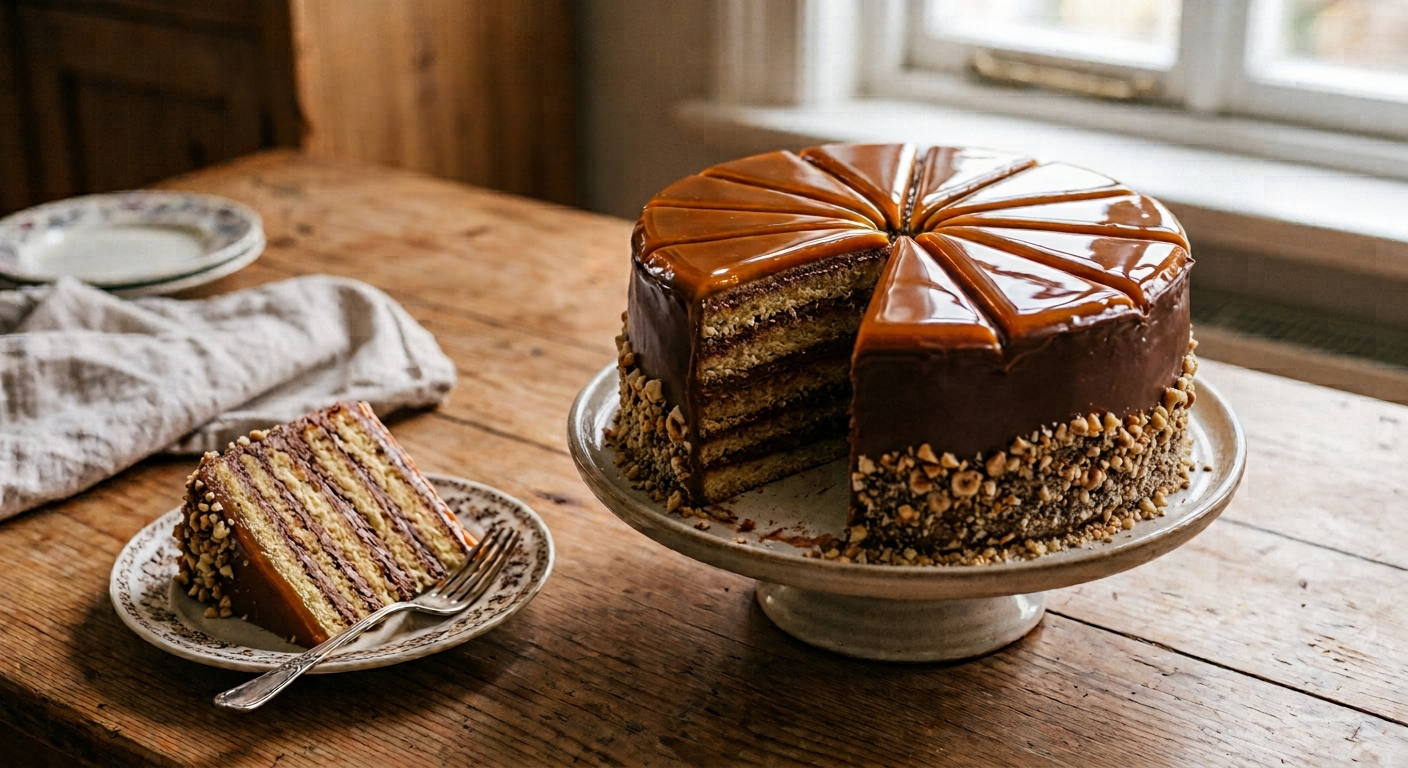
The classic Dobos torte consists of six thin sponge layers with five layers of chocolate buttercream between them. The final sponge is covered with hardened caramel.
Each sponge layer is baked separately instead of baking one deep cake and slicing it horizontally. This produces the fine, even layers that give the torte its characteristic striped appearance.
The caramel-covered sponge is cut into individual portions before the caramel hardens completely. These pieces may be laid flat over the cake or arranged at an angle over buttercream rosettes to form a fan-like crown. The sides are traditionally finished with buttercream and may be covered with ground hazelnuts.
Modern versions sometimes contain seven or more sponge layers, but additional height is not a requirement of the traditional cake.
Why Is It Called Dobos Torte?
The cake is named after József C. Dobos. Outside Hungary, its name is sometimes written phonetically as Dobosh torte.
It has also occasionally been translated as “drum cake” because the Hungarian word dob means “drum” and dobos can mean “drummer”. Its name, however, refers to its creator rather than its shape or caramel surface.
A Closely Guarded Recipe
The success of Dobos torte encouraged other bakers to produce imitations. Dobos kept his precise recipe secret for many years, and competing versions reportedly failed to reproduce the texture of his chocolate buttercream.
When he retired in 1906, Dobos gave the recipe to the Budapest Confectioners’ and Gingerbread Makers’ Guild. By making it available to fellow professionals, he allowed Hungarian confectioners to prepare the cake according to his method.
This decision helped preserve Dobos torte as part of Hungary’s wider baking tradition rather than leaving it solely as the product of one business.
Dobos closed his shop soon afterwards. He died in Budapest in 1924, but the cake bearing his name was already established as a classic.
How Dobos Torte Influenced European Baking
Dobos did not invent sponge cake, buttercream or caramel. His achievement was bringing them together in a distinctive and carefully engineered form.
The cake demonstrated that buttercream could provide both richness and greater stability in an elaborate layer cake. Its individually baked sponge rounds also created a precise internal structure that became closely associated with Central European tortes.
Its success encouraged imitation and helped popularise the combination of multiple thin cake layers and buttercream. Just as importantly, Dobos approached storage, presentation and transportation as essential parts of the cake’s design. This allowed a speciality created in Budapest to be sold and admired across Europe.
From Budapest Innovation to Hungarian Classic
In 2019, Dobos torte was admitted to the Hungarikum Collection, which recognises achievements and products considered especially important to Hungarian culture.
More than 140 years after its public debut, it remains a familiar sight in Hungarian confectioneries and coffee houses. Some bakers change the number of layers or reinterpret its presentation, but chocolate buttercream, thin sponge and caramel remain essential to its identity.
Dobos torte endures because it is more than an impressive layer cake. It reflects the ingenuity of a 19th-century food entrepreneur who created a dessert suited to the tastes, technology and expanding connections of his time.
Try our Dobos Torte Recipe to recreate Hungary’s classic layer cake, with thin sponge layers, rich chocolate buttercream and a crisp caramel crown.
References
Csapó, Katalin and Tibor Éliás. Dobos és a 19. század cukrászata Magyarországon. Hungarian Museum of Trade and Tourism, 2010.
Hungarikum Committee. Proposal for the Inclusion of Dobos Torte in the Collection of Hungarikums.
Bánfalvi, Carolyn. “Dobos Torta: Hungary’s Iconic Layered Beauty.” Taste Hungary, 2019.
Magyar Konyha. “Dobos mester a múlt ködében.” 2012.
Budapest Centre of Economic Vocational Training. “Dobos C. József Hospitality Technical and Vocational School.”