Around the World in 80 Bakes: Stop #59 — Karpatka
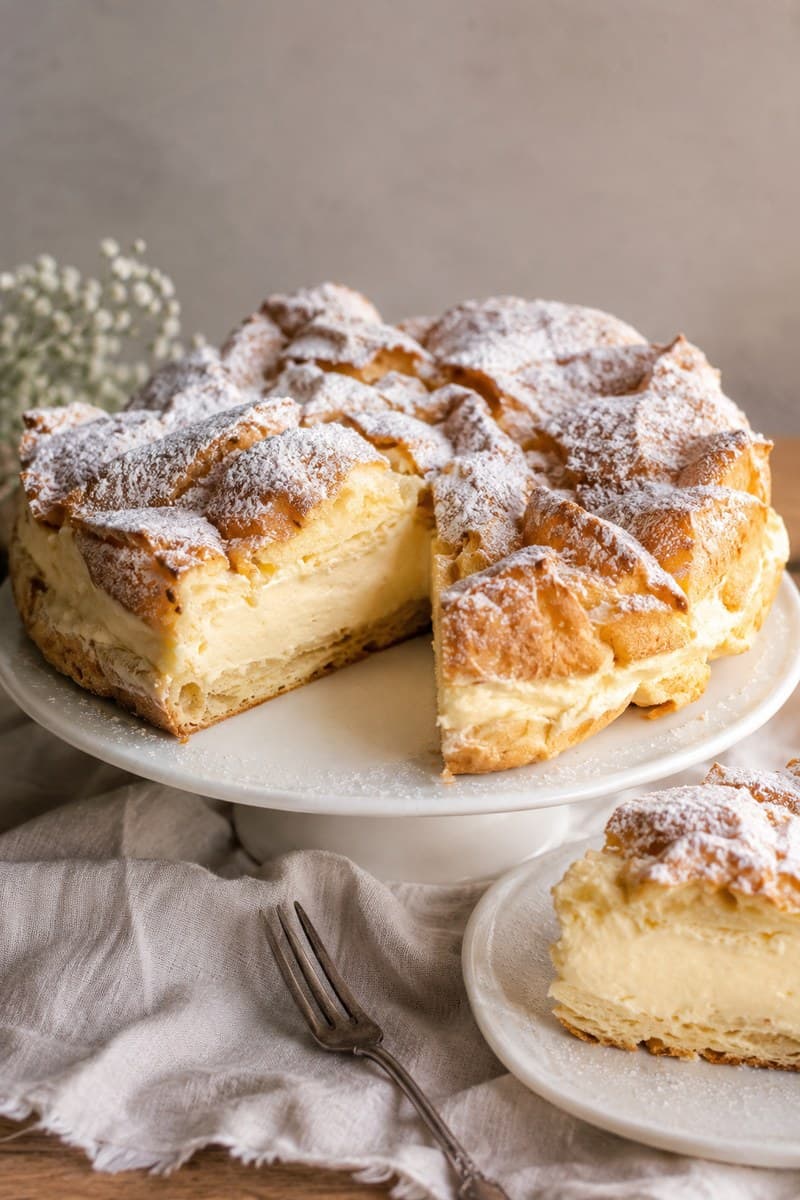
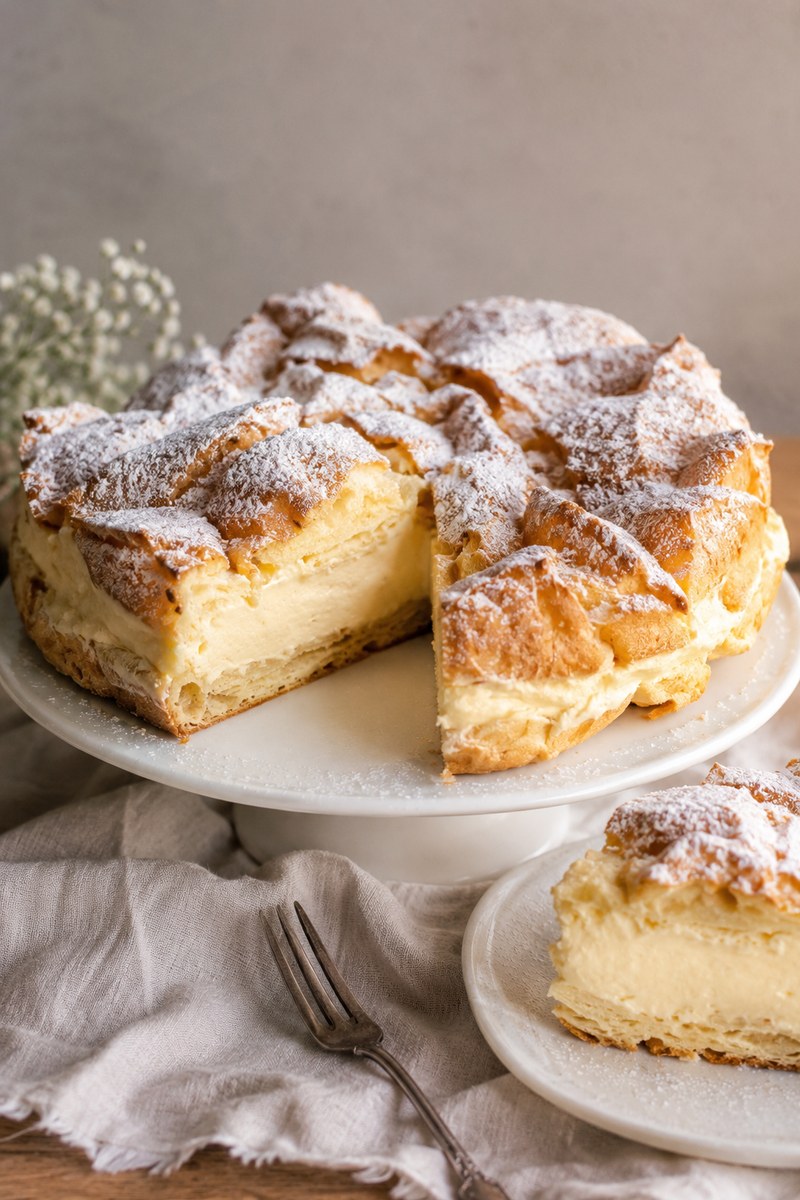
Golden choux pastry rises into rugged peaks and deep valleys, sandwiching a generous layer of smooth vanilla cream beneath a snowy dusting of icing sugar. Karpatka resembles a miniature mountain landscape sculpted in pastry — and it is this wonderfully irregular surface that gave the Polish cake its name.
Today, karpatka is regarded as a Polish classic, familiar at family gatherings, celebrations and alongside a cup of coffee or tea. Yet unlike many traditional European cakes with histories stretching back centuries, karpatka appears to be a surprisingly modern creation.
Its precise inventor and place of origin have been lost to history. What we do know is that the earliest documented mention of karpatka dates from 1972, making its story considerably younger than its old-fashioned appearance might suggest.
Why Is It Called Karpatka?
The name karpatka comes from the Carpathian Mountains, or Karpaty in Polish.
Stretching in a great arc through Central and Eastern Europe, the Carpathians pass through several countries, including southern Poland. Their ridges and snow-covered peaks provided the inspiration for one of the most distinctive-looking cakes in Polish baking.
The connection becomes obvious when karpatka emerges from the oven.
Choux pastry does not bake into a smooth, orderly sheet. Steam trapped inside the dough causes it to balloon upwards in unpredictable places, creating ridges, hollows and dramatic peaks. Once the top is covered generously with icing sugar, those golden folds begin to resemble a snow-covered mountain range.
The unevenness is therefore not something a baker should try to correct. With karpatka, the bumps are part of the design.
Polish cultural sources describe precisely this resemblance between the pastry’s natural “highs and lows” and the Carpathian landscape as the origin of the cake’s name.
When Was Karpatka Invented?
The exact origin of karpatka is unclear, and no single inventor or precise date can be identified. It likely developed in mid-20th-century Poland, though the earliest confirmed references appear later.
The first known published mention of the word karpatka dates to 1972, when it appeared in a text for students of Polish philology as the name of a type of cake or pastry. A confectionery textbook from around the same period, Wyroby ciastkarskie, also included instructions for making karpatka.
The earliest documented references therefore place karpatka firmly in the 20th century. Although relatively modern compared with many European pastries, the cake went on to become firmly established as a Polish classic.
Rather than having a single documented inventor, karpatka appears to have emerged gradually in 20th-century Poland before becoming widely popular in the decades that followed.
An Older Pastry Behind a Modern Polish Cake
Karpatka itself may be relatively young, but the technique responsible for its mountainous appearance is much older.
Its characteristic pastry is choux, known in French as pâte à choux — the same family of pastry used for éclairs, profiteroles and cream puffs.
Unlike conventional cake batter, choux begins by cooking flour in a mixture of liquid and fat before eggs are incorporated. The resulting dough contains a high proportion of moisture. In the heat of the oven, that moisture turns to steam, forcing the pastry to expand.
For éclairs and profiteroles, bakers generally pipe the dough into controlled shapes.
Karpatka takes a rather different approach.
The choux is spread into large sheets or rounds and allowed to rise as it pleases. The result is gloriously uneven: precisely the craggy appearance required for the cake’s mountain-like top.
What Is Traditional Karpatka Made From?
The version now most commonly associated with Polish home baking consists of two layers of choux pastry surrounding a thick vanilla cream.
The filling varies from recipe to recipe. It may be a classic pastry cream, a cooked vanilla custard enriched with butter, or another rich milk-based cream.
The result is the contrast that defines karpatka: light, slightly crisp pastry against a cool, soft and generous filling.
Other versions also exist. Some traditional recipes combine choux pastry with shortcrust pastry and may include a thin layer of marmalade beneath the cream. The two-choux-layer version, however, has become especially familiar in Polish home baking.
Once assembled, karpatka is usually chilled before serving and finished simply with a generous dusting of icing sugar.
No elaborate piping or smooth glaze is needed. The pastry’s own ridges and peaks provide all the decoration.
Karpatka Becomes a Polish Favourite
By the 1970s and 1980s, karpatka had become increasingly established in Polish baking culture.
Its ingredients are relatively simple, yet the finished cake has a striking appearance. Baked in a large tray or tin and cut into squares or rectangles, it is also well suited to family gatherings, celebrations and sharing.
As its popularity grew, commercially prepared karpatka products began appearing in Polish shops. Packaged mixes for the pastry and cream made the cake easier to prepare at home and helped introduce it to more households.
What had once been a relatively new confection gradually became familiar enough to feel traditional.
That shift is one of the most interesting parts of karpatka’s history. A bake does not need centuries of history to become closely associated with a country’s food culture.
Sometimes a few generations are enough.
Karpatka and Kremówka: Are They the Same?
Karpatka is sometimes confused with another famous Polish cream cake, kremówka, also known in some contexts as napoleonka.
The resemblance is understandable. Both combine pastry with a generous creamy filling and are commonly served in square or rectangular portions.
The key difference lies in the pastry.
Kremówka is generally made with crisp layers of puff pastry, while karpatka is distinguished by choux pastry and its characteristic ridged top.
Those irregular peaks are what give karpatka its distinctive appearance — and its name.
From Polish Kitchens to Bakers Around the World
Karpatka has gradually found an audience beyond Poland, where it is often described as Polish Carpathian Mountain Cake, Polish cream cake or even a giant cream puff cake.
Its distinctive appearance has undoubtedly helped it stand out.
Cut into a generous slice, the cake reveals a thick layer of pale vanilla cream between golden pastry, while the icing-sugar-dusted peaks above make it instantly recognisable.
Modern bakers have also experimented with the traditional formula, adding fruit, chocolate and other flavours to the filling. Yet the feature that defines karpatka remains unchanged.
The mountains stay.
The Beauty of an Imperfect Cake
Perhaps the most charming thing about karpatka is that it celebrates exactly what bakers are so often taught to avoid.
An uneven surface is desirable. Dramatic peaks are welcome. One side need not rise exactly like the other.
Every batch of choux creates its own landscape.
Once dusted with icing sugar, those ridges and valleys reveal the inspiration behind the cake’s name, resembling a miniature stretch of the snow-covered Carpathian Mountains.
Karpatka may not have the centuries-old history of some European pastries. Its earliest documented mention dates only to 1972.
Yet in the decades since, this wonderfully imperfect mountain cake has earned a firm place in Polish baking — a reminder that a classic does not need to be ancient to become beloved.
Want to bake it yourself? Try our Traditional Karpatka Recipe, with crisp choux pastry and a rich vanilla cream filling.
References
Culture.pl, The Craziest Cakes Poland Has to Offer.
Smaker.pl, Karpatka — skąd pochodzi przepis i nazwa tego wypieku?
Wyroby ciastkarskie, Polish confectionery teaching material referenced in accounts of the cake’s early history.