
Around the World in 80 Bakes: Stop #55 — Cherry Clafoutis
My cherry tree is now full of red cherries ready to be picked. Seeing so much ripe fruit on the branches made me think of cherry clafoutis, which was also one of the classic bakes I learnt to make in pastry school.
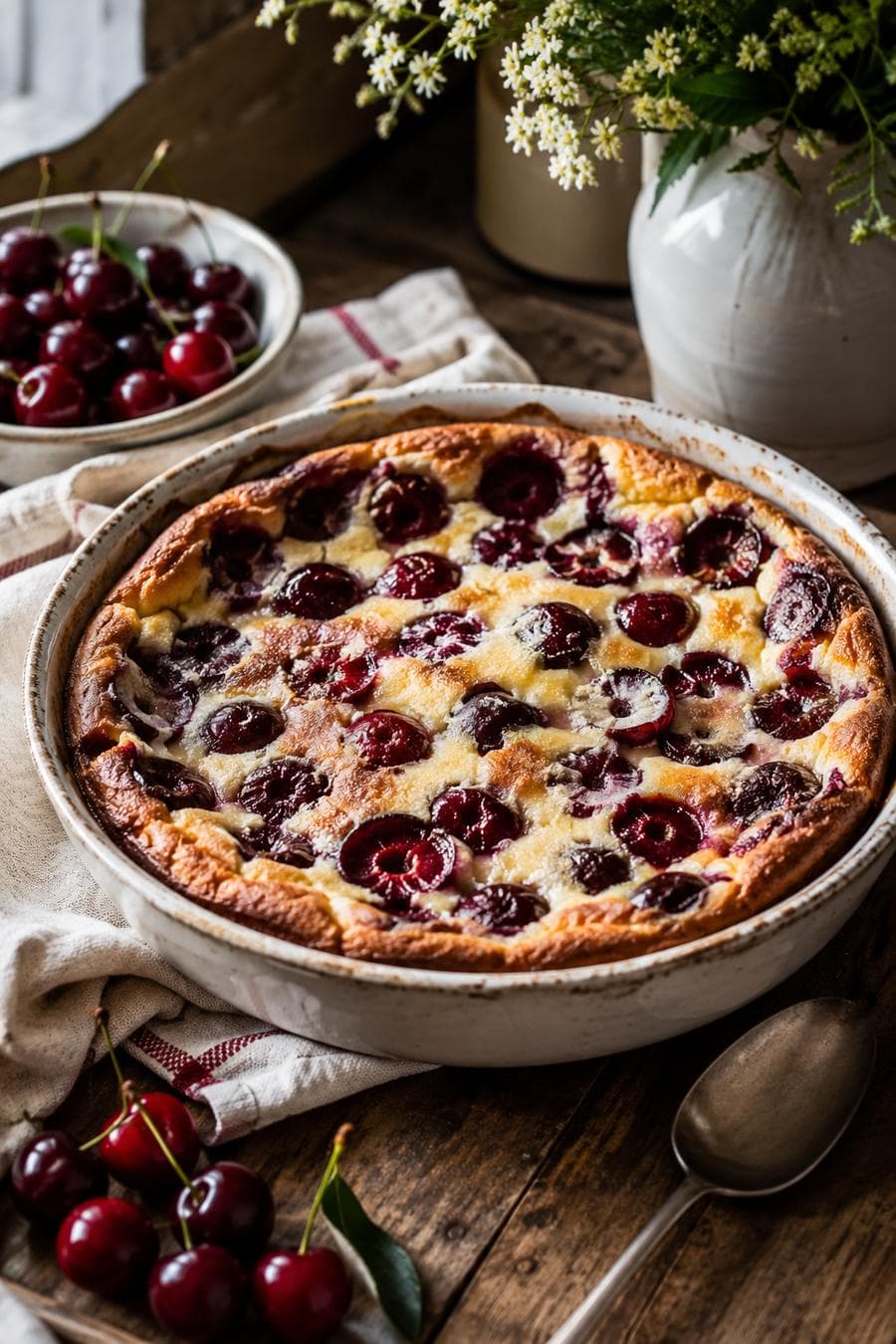
Clafoutis is a simple French dessert in which cherries are baked in a lightly sweetened batter made with eggs, milk, flour and sugar. As it cooks, the batter rises around the fruit and turns golden at the edges, while the centre remains soft and custard-like.
Although clafoutis is now made around the world, it began as a regional speciality from Limousin in central France, where the traditional version was prepared with whole black cherries.
What Is Cherry Clafoutis?
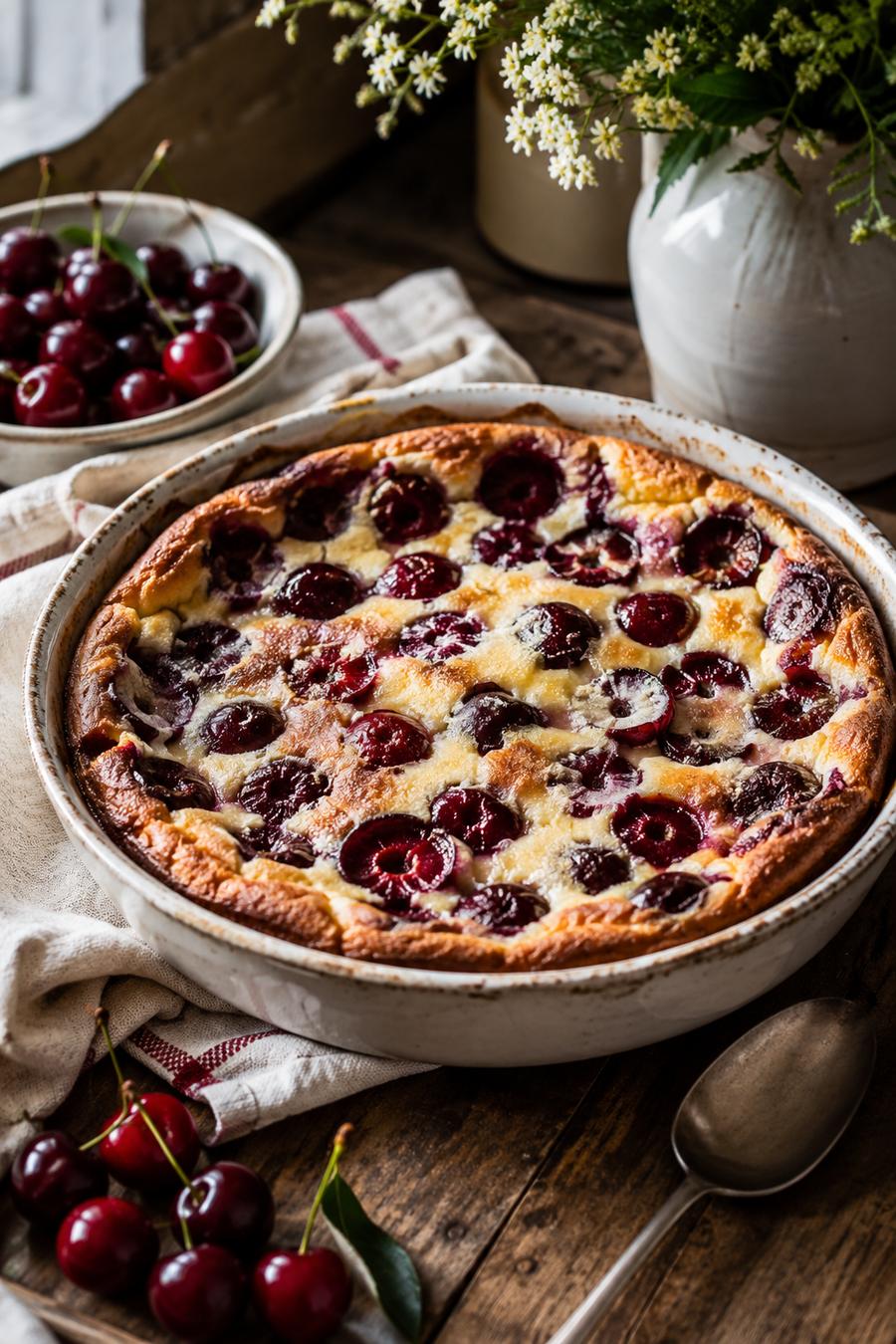
Cherry clafoutis is made by arranging cherries in a buttered baking dish and pouring a smooth batter over them.
During baking, the eggs set the mixture while the flour gives it enough structure to surround the fruit. The cherries soften and release some of their juices, leaving streaks of red and purple through the pale batter.
French dictionaries generally describe clafoutis as a type of fruit flan. Its texture, however, can vary considerably. Some versions are firm enough to slice into wedges, while others remain soft and are better served with a spoon.
It is neither a conventional cake nor a true custard. It is best understood as a baked fruit dessert made with a flour-thickened egg batter.
The Origins of Clafoutis in Limousin
Clafoutis originated in Limousin, a historic region of central France that is now part of Nouvelle-Aquitaine.
Its precise date of creation is unknown. Like many regional dishes, it was probably prepared in local homes before its name and method appeared in print.
The earliest detailed written description that can be readily traced appears in Hippolyte-François Jaubert’s Glossaire du Centre de la France, first published between 1856 and 1858.
Jaubert described clafoutis as a cake containing small black cherries, with approximately as much fruit as batter. The liquid mixture, with the cherries floating in it, was poured into a shallow dish with slightly raised edges and baked in the oven.
This entry is more of a description than a complete recipe. It provides no precise quantities or baking instructions, but it clearly records the defining features of clafoutis: plenty of dark cherries suspended in a liquid batter and baked in a shallow dish.
The term was recorded as part of the dialect of central France by the 1860s and had entered more general French usage by 1866.
One of the Earliest Printed Recipes
A fuller recipe titled Clafoutis aux cerises appeared in French chef Urbain Dubois’s Nouvelle Cuisine Bourgeoise pour la Ville et pour la Campagne.
The recipe can be found in the eighth edition, published in 1888. It is one of the earliest clearly identified clafoutis recipes in a widely distributed French cookery book.
It cannot be described with certainty as the first printed recipe. Regional dishes were often passed from one generation to another without being written down, and earlier recipes may have appeared in local publications that have not survived or been digitised.
Nevertheless, Dubois’s recipe shows that clafoutis had moved beyond regional speech and household practice into mainstream French cookery books by the late 19th century.
What Does the Name Clafoutis Mean?
The word clafoutis comes from regional speech associated with central and western France.
It is derived from clafir, meaning “to fill”, which in turn developed from the Old French claufir, meaning “to fasten with nails”. Over time, the word acquired the broader sense of filling or scattering something across a surface.
In a clafoutis, the batter is generously filled or studded with cherries.
It is sometimes suggested that the dark cherries dotted across the pale batter resemble nail heads. This is an appealing visual interpretation of the word’s history, but it is not a proven account of how the dessert was named.
Why Traditional Clafoutis Used Whole Cherries
Traditional Limousin clafoutis was made with whole, unpitted black cherries.
Leaving the fruit intact saved the considerable work of removing the stones from many small cherries. It also prevented too much juice from escaping into the batter before baking and helped the fruit retain its shape.
Traditional cooks have long maintained that the stones give clafoutis a faint almond-like fragrance as they warm in the oven. This remains one of the best-known arguments for making the dessert with unpitted cherries, although the extent of the flavour is difficult to measure.
Whole cherry stones must not be bitten or crushed. The kernels inside contain amygdalin, which can release cyanide when they are broken and chewed. Diners should therefore always be warned when stones remain in the dessert.
For family baking, particularly when serving children, pitted cherries are the safer and more convenient choice. A restrained amount of almond extract may be added to complement the fruit.
Why Black Cherries Are Traditional
Traditional French definitions identify black cherries as the characteristic fruit of clafoutis.
Jaubert’s 19th-century description referred specifically to small black guigne cherries. Guignes are sweet cherries with softer, juicier flesh than the firm bigarreau varieties often sold in supermarkets.
As the fruit bakes, its skin softens and its juice stains the surrounding batter. The contrast between the dark cherries and the pale, egg-rich mixture is one of the dessert’s defining features.
Modern clafoutis can be made with many varieties of fresh cherry, including fruit grown in home gardens. The amount of sugar should be adjusted according to the flavour of the harvest.
Very sweet cherries require less sugar, while sharper varieties may need a little more.
Clafoutis or Flognarde?
Many modern recipes use the name clafoutis for almost any fruit baked in a similar batter.
In traditional regional usage, however, clafoutis is closely associated with cherries. A related Limousin dessert made with apples, pears, plums or other fruit is often called a flognarde, also spelt flaugnarde.
The distinction is not followed consistently. The current dictionary of the Académie Française defines clafoutis broadly as a fruit flan and gives both black-cherry and apple versions as examples.
Nevertheless, many cooks maintain that a true clafoutis should contain cherries. This attachment to the traditional fruit became particularly clear during a twentieth-century disagreement over the dessert’s dictionary definition.
The French Debate Over Clafoutis
In 1964, the definition of clafoutis caused a small stir at the Académie Française.
When the institution described it broadly as a type of fruit flan, objections were raised by those who felt the wording ignored its Limousin identity and its traditional connection with black cherries.
The disagreement was reported in the French press and illustrated how strongly regional communities can feel about their food traditions.
To many people in Limousin, clafoutis is not simply batter baked with any available fruit. It is a particular cherry dessert connected with the produce, language and culinary traditions of the region.
The Académie Française’s present definition remains broad, however, showing that common culinary usage is often less rigid than regional custom.
From Regional Bake to French Classic
By the late 19th century, clafoutis had entered both French dictionaries and published cookery books.
Its straightforward method probably helped it become more widely known. It required no pastry, elaborate shaping or specialist equipment. Cherries were placed in a dish, batter was poured over them and the dessert was baked until set.
Modern recipes may include vanilla, lemon zest, cream, kirsch, almond extract or ground almonds. Some bakers pit the cherries, while others remain faithful to the traditional method.
Despite these variations, the basic preparation remains remarkably close to Jaubert’s 19th-century description: a shallow dish filled generously with dark cherries suspended in a liquid batter.
A Classic Bake for Cherry Season
The earliest written descriptions present clafoutis not as an elaborate pâtisserie, but as a straightforward regional bake containing almost as much fruit as batter.
Modern bakers may pit the cherries, adjust the sweetness or add a hint of almond. Yet the character of the dessert remains largely unchanged: plenty of ripe cherries held within a soft, golden baked batter.
When a cherry tree is laden with fruit, clafoutis feels like the natural bake to make.
Inspired to bake this French classic at home? Try my easy Cherry Clafoutis Recipe, with juicy cherries baked in a soft, custard-like batter.
References: Jaubert, H.-F. Glossaire du Centre de la France. 1856–1858; Centre National de Ressources Textuelles et Lexicales. “Clafoutis”; Dubois, U. Nouvelle Cuisine Bourgeoise pour la Ville et pour la Campagne. 8th ed., 1888; Dictionnaire de l’Académie Française. “Clafoutis”; Centre National de Ressources Textuelles et Lexicales. “Flognarde.”